The Double Jeopardy Clause of the US Constitution's 5th Amendment states that no "person [shall] be subject for the same offense to be twice put in jeopardy of life or limb." This applied only to cases held in Federal courts for almost 200 years until Benton v. Maryland (1969). Thurgood Marshall, writing for the majority, declared that the 14th Amendment's Due Process Clause incorporates the Double Jeopardy Clause, that is, no state can try someone twice for the same offense either.
Last week, the National Hellenic Museum of Chicago trampled our 5th Amendment protections when they retried Socrates. In 399 BC, the Athenian Assembly convicted a 70 year old Socrates of impiety and corrupting the youth and sentenced him to death. In a fundraising bid, the museum hosted not a reenactment, but a second hearing for the alleged offenses.
Socrates
Public Domain
Judge Richard Posner presided over the trial. Judge Posner, graduate of Harvard Law School, was appointed to the 7th Circuit by President Ronald Reagan. He recently handed down the verdict overturning the Illinois concealed carry ban in Moore v. Madigan. Also presiding were the semi-retired Judge William Bauer, educated at DePaul and appointed by President Ford, and Cook County Judge Anna Decamopoulos, who studied law at John Marshall Law School.
Judge Posner
chensiyuan
Representing the 5th century BC Athenian Assembly, was Harvard trained prosecutor Patrick Fitzgerald. Fitzgerald has brought down his share of criminals, prosecuting Mafia boss John Gambino and Governors George Ryan and Rod Blagojevich. Patrick Collins, who assisted Fitzgerald in the prosecution of Governor Ryan, filled out the prosecution team.
Patrick Fitzgerald
Public Domain
Dan Webb (no relation), who defended Governor Ryan as well as General Electric and Microsoft in antitrust litigation and Philip Morris in tobacco-related litigation and prosecuted Admiral Poindexter in the Iran-Contra Affair, led Socrates' defense team. He was assisted by Robert Clifford, noted for securing damages for victims of major airline crashes.
Dan K. Webb
Charles Rex Arbogast
Fitzgerald pointed out Socrates' pro-Spartan sentiments, the equivalent of wearing a Gorbachev t-shirt during the 80s. He also noted how prominent students of Socrates' committed crimes against the state, Alcibiades defecting to Sparta and Critias repressing Athenian freedom. Fitzgerald claimed historians have been unfair to Athens and blamed Plato for distorting the facts of the case.
Webb cited the overwhelming lack of evidence in the case and pointed to Socrates' status as a veteran, having served with distinction in the Athenian military and saved the lives of fellow soldiers. He claimed that the speculation on the part of the prosecution endangered the liberties of us all.
A jury of 12 distinguished members of the Chicago community found Socrates guilty of impiety and corrupting the youth... again. Instead of sentencing him to death a second time, the jury opted for a fine of 3,000 5th century Greek Drachmas, an equivalent of $132,000 in 2013. There has been no word on whether or not the defense plans to appeal the ruling.
A Jabbo Allen Special Edition
Reporting to you from the bottom of the fiscal cliff we tumbled over last night because our elected legislators wanted to make it home for dinner. At 2 am this morning, the Senate passed the American Taxpayer Relief Act of 2012 with a vote of 89-8. Two hours after the dreaded Fiscal Cliff. Which means we skittered over the edge. Life as we know it is over. It's now headed over to the House for a post-mortem examination.
Apparently, the resulting bill from these long months of negotation, resembles the sort of compromise for which we hired our esteemed representatives. Digging in like a sullen teenager is fun every once in a while, but I want to get my money's worth out of the US Legislature. I want to see Wheeling and Dealing. Give and Take. Federal Reserve Chairman Ben Bernanke coined the term "fiscal cliff" in February 2012. It has taken them ten months not to pass a budget. It took our Founding Fathers only four months to invent our whole government from scratch. They were all Classics majors, by the way.
According to the venerable New York Times, this recent deal includes:
An increase in the estate, dividends, and capital gains taxes
A phase out of of the Bush era tax cuts
A provision to protect the Middle Class from the AMT
An extension of unemployment benefits
We didn't actually stay up until midnight. Really, a New Year's Eve without the Holmeses is like a Margarita without Cointreau. What's the point?
Haute Cuisine
Today, January 1st, 2013, all across the South, my friends and countrymen (and countrywomen) will be partaking of that New Year's staple, black-eyed peas. But why?
Black-eyed peas are the central dish eaten at Rosh Hashana, the Jewish New Year. Jews celebrate the Talmud as the second most important text in Judaism, the first being the Torah, also known as the five books of Moses (Genesis, Exodus, Leviticus, Numbers, Deuteronomy - isn't it funny how our names for these books all come from Greek?). In two places (Horayot 12A and Kritot 5B), the Talmud prescribes black-eyed peas as the officially sanctioned Rosh Hashana meal. This tradition came to America with Sephardi Jews that migrated to Georgia in the 1730s. By the 1860s, this traditional meal had spread to the non-Jews of the Deep South. Many blame Sherman.
William Tecumseh Sherman captured Atlanta in mid-November of 1864. I'm sure you've seen Gone with the Wind. You know what I'm talking about. From mid-November to late December, Sherman marched to Savannah on the coast, keeping or destroying all live stock and food crops in his path. According to legend, the Union troops didn't destroy Field Peas, a crop considered only fitting for livestock in the North. Since the Yankees took all the livestock anyway, the disgusting field peas didn't merit their effort. The survivors of Sherman's march had only field peas, known to us as black-eyed peas, to eat in the New Year.
A traditional New Year's meal includes black-eyed peas, greens (they could be mustard, collard, turnip, or, as my family always served, cabbage), pork (we always had sausage), and cornbread.
Peas symbolize prosperity because they swell when cooked. Greens symbolize money, obviously. Pork represents positive forward motion in life because pigs move forward when foraging. On the other hand, lobsters (which move backwards) and chickens (which scratch in reverse) are verboten for New Year's meals since they represent regression. Cornbread symbolizes gold.
Some people add a penny to the pot of black-eyed peas to make it extra lucky. Technically, you have to eat exactly 365 peas to extend your luck over the entire year.
Snow Again
Yesterday it snowed all day long.
This morning, the New Year greeted us with a muffled huzzah under layers of snow. So, I have some quick snow facts for you.
Nature makes four types of snow:
Columns - tiny little cylindrical crystals with six sides
Dendrites - your classic snowflake, it looks like a star with six points
Needles - needle-shaped crystals, as you can probably tell from the name
Rimed Snow - these dendrites are coated with frozen water droplets
In the movies, when the protagonist trudges through the snow and you hear that perfect crunching noise, you're actually hearing the cornstarch, salt, or cat litter used by the special effects department. Real snow doesn't sound like that. At low temperatures (in the teens), snow squeaks. Our snow made a sort of squeaky-poppy sound like a cross between bubble wrap and scooting forward on a leather sofa.
I took some time to observe and record tracks in the snow from indigenous wildlife. Here are my results:
Organized Labor
Michigan governor, Rick Snyder (Republican), signed Michigan's first Right to Work bill into effect last week. This occurred only months after Indiana passed a similar law, indicating an ebb of organized labor's political influence in the Midwest. Pundits consider Michigan, the birthplace of the American Auto Industry and historical bastion of organized labor, the "defining domino." Whatever that means. I don't do metaphor.
The provisions in the law state that membership in a union can't be required as a prerequisite for employment, and, more importantly, that a union can't take money out of your paycheck even if you aren't a member. This is usually the defining factor of union political influence. Unions claim that all workers in an industry should pay dues, even if they refuse membership, since all workers benefit from union activity. Of course, you don't have to belong to the union, a provision that sounds eerily reminiscent of Robert Cormier's The Chocolate War. A new kid opts out of the voluntary school fund raiser, selling chocolate, and soon becomes a social pariah, scorned by both students and teachers. The book ends with him beaten to an unrecognizable pulp. It's a kid's book. Check it out.
According to theory, since the union can't force you to pay, union revenue shrinks and the union can no longer effectively represent its members. Proponents of organized labor vilify this legislation as a political move to undermine union power and that Right to Work will actually kill the Michigan economy. Opponents state a fear of losing commercial enterprise to Indiana and claim breaking union power will invite more industry to Michigan and improve the economic conditions of the state.
Unsurprisingly, the economic claims of both sides, made by partisans rather than economists, have no real basis in reality. Economics unfolds slowly, so Indiana is too fresh to produce revealing data. Most of the southern states passed Right to Work legislation in the late 40s, seeing a steady economic increase. Economic historians think this has more to do with Eisenhower's interstate highways and the invention of the air conditioner. The former making southern industry accessible and the latter making factory work bearable in the summer months.
The only states to pass Right to Work legislation in the measurable past from which economists can gather relevant data have been Idaho (1985) and Oklahoma (2001). Okies actually wrote a Right to Work section into their state constitution rather than enact legislation. I don't know that you can tell much from Idaho: the state has a population around the size of the Austin Metro Area. Results from Oklahoma have been mixed. Mostly due to bad timing on the part of Okies. They went Right to Work just in time to catch two national recessions.
Long story short, we don't have enough information, aside from partisan rhetoric, to say how Right to Work versus Organized Labor affects a state's economy. It's entirely possible that the union question is entirely beside the economic point. Texas is Right to Work. New York is not. They have similar populations and nearly identical state GDPs.
Right to Work States
Wikimedia Commons - Scott5114
Concealed Carry
Last week in Moore v. Madigan, the 7th Circuit Court of Appeals issued a 2-1 decision that the Illinois law banning concealed firearms was unconstitutional. Illinois was the only state in the union banning concealed firearms. The court called the law the "most restrictive gun law in the US" and gave the state legislature 180 days to come up with a better idea. Word on the interwebs is that State Attorney General Lisa Madigan may be preparing to appeal the decision before the Supreme Court, a worrisome proposition for both sides of the argument as the Supreme Court's decision would impact all states and not just Illinois. I know what you're wondering. You're wondering, on what basis can she appeal and how does this case fit into legal history? You're lucky I'm here.
Bill of Rights 1789
The 2nd Amendment established the right to bear arms with a single line: "A well regulated Militia, being necessary to the security of a free State, the right of the people to keep and bear Arms, shall not be infringed." To the Classically-trained Founders, a line like this, which would make perfect sense in Latin or Greek, comes across a wee bit ambiguous in English. Centuries of bickering has ensued, basically over whether the Founders would have put a so or an and between "free state" and "the right of the people." Foremost in the Founders' minds was fear of the political influence of a standing army and the reluctance to shell out the cash for one. State militias with self-armed citizens had long been the first line of defense through the several wars of the 1600s and 1700s. Implicit in this was the necessity of firearms for personal defense and hunting since over 90% of the population lived in the boonies. Also important are the due process clauses of the 5th Amendment, which says the federal government can't take your property without the due process of law, and the later 14th Amendment, which says the states can't do it either.
Robertson v. Baldwin 1897
The Supremes ruled that a ban on concealed weapons does not infringe on the right to bear arms.
District of Columbia v. Heller 2008
In a landmark case, the Court (split 5-4 as always) interpreted the right to bear arms as a right to self defense within the home. This ruling only applied to Federal Enclaves, which pretty much meant Washington DC.
McDonald v. Chicago 2010
The 7th Circuit Court of Appeals upheld a Chicago ban on firearm ownership in the home. This case shuffled up to the Supremes, who, in another 5-4 decision, expanded Heller to include the states. The Court explained that gun ownership is protected by the 2nd Amendment and any state law to the contrary would violate the 14th Amendment.
Kachalsky et al v. County of Westchester 2012
A month before the Illinois decision, the 2nd Circuit Court of Appeals in New York ruled unanimously that concealed carry is not protected under the 2nd Amendment and only extended the concealed carry to those with a "distinguishable need" above that of the general population and folks engaged in a relevant profession. Translation: you can only carry a concealed firearm in New York if you get a badge or a sex change operation.
Moore v. Madigan 2012
The 7th Circuit decided that the state did not make a convincing argument that prohibiting concealed carry increased public safety and went on to expand Heller: the right of self defense extends beyond your front door since one is more likely to encounter violent situations outside the home. Especially in Chicago.
Since Moore came close on the heels of Kachalsky and the two are contradictory, an escalation to the Supreme Court is being anticipated to settle the matter. It's notoriously difficult to get a case into the Supreme Court. A case has to be relevant, it has to compel an interpretation of the Constitution. It has to be fresh, not an issue clearly decided in a previous case. It helps if the issue has been decided differently by different courts. Moore meets all these criteria. Gun ownership is a done deal. Protected by the 2nd Amendment. However, still open are questions about what types of guns you can own, where you can take them, and how much say a state has in the matter.
A Jabbo Election Day Special Edition
It's been at least four years since I've heard as much polarized rhetoric and paranoia. Republicans believe that if Obama wins, the nation will become a godless, socialist wasteland like Stalin's Russia. Democrats believe that if Romney wins, the nation will slide back into the feudal squalor of the Middle Ages.
Well, Crankles and Piglet are unimpressed with your dire forebodings:
Food for Thought
So, I'm reading a biography of Abraham Lincoln (Lincoln by David Herbert Donald) and I flipped to a map of the states preceding the Civil War. I thought it looked eerily similar to a recent map I saw online of states preceding the Tuesday election.
I'm not going to draw correlations between the two maps. You could easily spin the argument in either direction, even over a single issue, like healthcare. The political issues dividing the nation in 1860 are bad memories and foregone conclusions to us in 2012. The political issues dividing us today would be largely incomprehensible to the Americans of 1860. An attempt to draw a line from one set of issues to the other would be sloppy scholarship. And stupid.
I'm also not trying to draw conclusions about the results of the 1860 elections that could be applied today. Again, completely different political climates. Anything said to the contrary would be tantamount to paranoia.
What I find interesting is how the polarization resulting from a two party system (why anyone thought that was a good idea baffles me) falls roughly along the same geographic lines that it did over 150 years ago. How, in a time when technology has connected the world in a manner unprecedented in human history, our political beliefs are still determined largely by our zip code.
US Map 1863
Public Domain
US Election Results 2008
Public Domain
Note:
The modern two party system we have today, Republicans vs Democrats, was born in that 1860 election. From the 1870s into the 1920s, politics fell along the same geographical lines, only with the Northern States going to the Republicans and the Southern States going to the Democrats. After the Great Depression, politics vacillated wildly. For the most part, and I'm making generalizations here about electoral college results, during the 30s and 40s the maps look almost all blue. During the 50s, the Eisenhower years, the maps reverted back to the pre-depression divisions, blue in the South, red in the North. Kennedy's election results are all over the map. Johnson's map is all blue. The Nixon elections are all red. The Carter election has an East/West split, the West going Republican and the East going Democrat. The Reagan/Bush maps are almost all red. It's not until the first Clinton election that you see the modern blue North/red South election results that we get today.
Depends on Who You Ask
After two hours of clandestine deliberations Tuesday, the teachers' reps for the CTU voted to end the strike with a 98% majority. Just in time, too. A judge scheduled the hearing for the injunction suit filed by Rahm Emanuel for early Wednesday morning. Karen Lewis says the injunction suit had no influence over the union rep decision. Over the next two weeks, the reps will review and decide on whether to approve the tentative agreement struck between Lewis and Vitale last Friday.
People have differing opinions over who won the strike and many have written blog posts and editorials explaining why. Proponents of the strike claim that valor and courage in the face of tyranny explains the outcome. The scrawny kid stood up to the town bully and got to keep his lunch money. Opponents of the strike point to the incremental gains in reform, complying with state law and national policy.
Let's Make a Deal
Here's a break down of who got what out of this messy ordeal:
Teachers
Struck down the merit pay system. The district proposed higher pay for teachers whose students perform better academically. CTU said no.
Any teachers laid off by a school closing will get preferential bids on new positions.
The District
Got a longer school day and a longer school year. Rahm Emanuel says that a student starting kindergarten after the new contract commences will spend the equivalent of 2.5 more years in the classroom.
Compromise
The teachers will receive the 3-2-2% raise bump that I explained in an earlier post. The district calculates that, including seniority raises and education raises (more money if you have a Master's) already in place, the average teacher will get a real raise of over 17% in the next four years. This will push the average salary very near the $90 thousand mark. Originally, the teachers demanded a 30% raise over the same period. This would have pushed the average salary well over $100 thousand a year.
Evaluations based on student performance remain, you know, since they are mandated by state law. However, the district has agreed to make student performance a lower percentage of the total evaluation and teachers who get bad evaluations have access to an appeals process.
So, after seven days, the strike has ended. Good thing, too. The 1987 strike over pay and length of the school day lasted a month.
Lake Forest
The Lake Forest strike ended yesterday as well. Wearing ties and sitting in camping chairs, the Lake Forest teachers protested for two or three days for raises and better benefits. 80% of the teachers in this district make $100 thousand a year or more. To be fair, though, 99% of them have Master's degrees and they produce some of the most successful students in the state. Depending on who is looking at these numbers, different people see different things. Some see a correlation between teacher pay and student performance. Some see a correlation between parent income and student performance. Some see a correlation between professional excellence and employee salary. I'm not good with all this Sociology stuff, so you decide.
Walmarch
Also ended. It was a march against Walmart. You see what they did there. Employees of a distribution company contracted by Walmart walked off the job last Wednesday. These warehouse workers, complaining about unsafe conditions, began a 50 mile/6 day hike across the state of California. Some farmworkers joined them. Warehouse workers in Illinois (here's where we tie it in) heard about the strike and joined it by walking off the job. Spokesman for Warehouse Workers United said, well, no, they don't technically work for Walmart, but Walmart dictates the standards of operations for its contractors, so there. And also Walmart sucks. End quote. The strike ended when Walmart said, sure, we'll look into all these allegations.
A Little Closer to Home
The union representing graduate student teaching assistants is threatening a strike over contract details. I'm new to the unionized part of the world. In Texas, unions are regarded much like third world air pollution: something far away that doesn't affect us. As such, I haven't paid attention to union activity. I don't know if this period between the blistering summer heat and the lethal winter winds, being conducive to standing outside with signs, is just Strike Season. Sort of like Hurricane Season on the Gulf Coast. Or if this goes on all year, like humidity in Houston.
Viking Schools
I read a blog about Finnish education. Finland has the best education system in the world (measured by student performance), followed closely by those syrup-guzzling socialists in Canada. Students don't start school until age 7, spend less time in the classroom than American students, and don't have to take a rigorous standardized test until grade 12. And they are outperforming us. The key is the teachers. It's not enough that they have a pulse and have just been doing it for a long time. All teachers in Finland have a Master's degree and only the top students can hope to compete for a teaching position. The profession is competitive and rigorous and is more revered than medicine or law in the US. All teachers are trained as researchers. This means, rather than adopting a teaching strategy akin to a frontal assault at Gallipoli, they actively evaluate themselves and their methods and find creative solutions for presenting curriculum. Also, they don't allow politics to influence education decisions made by administrators. They sort of treat education and politics like two different spheres. I know, it sounds crazy.
Cuz a CTU Party Don't Stop
Chicago teachers are still marching for Truth, Justice, and the American Way. CPS and the CTU came to a tentative agreement on Friday before going to happy hour. The final product, a three year contract, guarantees a yearly raise, a hiring pool that opens half of its positions to laid-off teachers, and a system for appealing poor evaluations.
The yearly raise scheme looks like this: teachers will receive a 3% raise the first year and 2% the next two years. I'll save you the math. This pushes the average pay of a Chicago teacher to over $80 thousand dollars a year. Chicago teachers currently make almost twice what Austin teachers make. Surely, this results from high cost of living in Cook County, one might surmise. I looked it up. According to Sperling's Best Places, the two cities have roughly the same cost of living index. Housing costs slightly more in Austin; groceries cost slightly more in Chicago. Salary.com and CNNMoney tell a slightly different story. They say the cost of living in Chicago is 25% more than in Austin and Chicago employers pay 12% more than Austin employers. This makes sense, but it doesn't account for Chicago teachers making double the salary of Austin teachers.
Nope!
So everyone's happy with the new contracts, right? Wrong. The CTU House of Delegates met on Friday to approve the agreement. They said it looked cool to them, but it would be inherently undemocratic to approve it without the consent of each individual teacher, many of whom are still dissatisfied with the terms. So the decision to unstrike will have to wait for the Union Representatives to meet and vote. Unfortunately, they can't squeeze a meeting into their schedule until Tuesday, so the teachers won't teach until Wednesday at the earliest. Karen Lewis says even Wednesday may be optimistic.
Rahm Emanuel responded by filing a request that the State Court file an injunction to force teachers back into their classrooms. A state law prohibits strikes on non-economic issues, including evaluations, layoffs, recall rights, length of the school day, and length of the school year. Pretty much all the reasons the CTU decided to strike. Also, Emanuel claims the strike endangers the health and safety of the children. For many of them, free school breakfast and lunch are they only meals they get on an average day. Since the strike affects mostly urban schools in poverty stricken neighborhoods, many of the kids who would be in schools are at home alone or on the streets in places where crime and violence are rampant. These aren't your suburban kids who spend the day playing X-box and eating Pizza Rolls.
It Gets Kooky
This strike coincides with the monthly Labor Department survey of employment. The Labor Department polls 141 thousand employers, including the Chicago Public School system. CPS runs a biweekly pay schedule, this one from September 9 through September 22. If the teachers don't return to the classroom by the end of the week, the Labor Department survey could show a decrease of 30 thousand jobs for this month. The same thing happened before, during the Verizon employee strike in 2011, the report showed a 50 thousand job loss.
The Labor Department goes back later, after no one's paying attention any more, and adjusts the numbers. But these raw numbers, the inaccurate numbers that don't matter, affect things like the stock market and elections and become the source of yet another unintelligible rant by Limbaugh the Hut.
Also, it doesn't have an effect on unemployment numbers. That's a different survey altogether.
The Parting Shot
My favorite part of this whole situation has been the giant inflatable rat I keep seeing in news images. The rat image gets used often in strikes to demonize employers who use non-union labor. Inflatable rats have become a frequent addition to major strikes and protests as a sort of rallying point. Most are named Scabby the Rat in reference to Scabs, folks who cross picket lines. This one in Chicago is a loaner from the Teamsters to the CTU just for this strike.
It's still going, this teacher strike. Both sides left the bargaining table at midnight last night, confident that today, all their hopes and dreams would come true. Although, even if they shake hands on a deal today, Karen Lewis says teachers won't return to their classrooms until Monday at the earliest. Any deal they make at the bargaining table must be approved by the CTU House of Delegates and they won't be able to meet until sometime tomorrow.
Democrats across the country have watched this strike with concern, since it seems to evidence a growing rift in the Democratic Party, much like the contention between Tea Party and Establishment Republicans. Organized Labor (specifically, teacher unions) no longer sees eye to eye with wealthy Liberals (the ones who contribute the most money to campaigns, but also send their children to charter schools and private schools). The Obama administration is still careful not to take sides in this issue.
Obama, I read, has had an uneasy relationship with teacher unions. On one hand, he defends collective bargaining and promises government moulah to districts in financial straits. On the other, he champions opening charter schools and closing underperforming schools.
Here's where it gets wicked. Performance based evalutations, the central issue of this strike, form a cornerstone of Race to the Top, Obama's policy introduced to reform Bush's No Child Left Behind.
In 2010, Democratic Governor of Illinois, signed into law PERA (Performance Evaluation Reform Act) to comply with Race to the Top (also to get the promised moulah). The addition of performance based evaluations to the Chicago school district policy was in compliance with the state law. Part of the Chicago plan stipulated that the new evaluations (only 40% based on student performance) would not be counted for the first year, to work out any bugs in the system and to allow teachers a period of acclimation to the new evaluation system.
The CTU, though, argues that the standardized tests do not take into account povery, claiming that students from lower income neighborhoods do poorly on such tests and it's not the teacher's fault. They want to strike down evaluations based on student performance and secure a promise that any teacher laid off as a result of a school closing will get a preferential bid for new positions.
A humble rebuttle to that theory has been proffered by a joint study from Harvard and Columbia. This study asserts that poverty has less an impact on student performance than teacher quality. A poor performing teacher has the same impact on a child as missing 40% of the school year. A child with a top performing teacher gets the equivalent of two extra months of education. Then there's all this mumbo jumbo about even one year with a good teacher lowers the chances of teen pregnancy and raises the chances of higher salaries as an adult. Read it for yourself if you have plenty of coffee: http://obs.rc.fas.harvard.edu/chetty/value_added.pdf
Yesterday, School Board President David Vitale promised to reach an agreement with the CTU. Union President Karen Lewis came out of the meeting accusing Vitale of feckless brigandry (my words, not hers, she went to Chicago public schools). The Union and the School Board meet again today. The Board will present a "comprehensive proposal" (AP words, not mine) to which the the Union will return a written response. Or some shenanigans like that. The strike continues.
Dramatis Personae
Because I like to know what the people look like. Imagine these guys sitting across a table from one another, screaming.
CTU President Karen Lewis
School Board President David Vitale
Mayor Rahm Emanuel
The Strike Spreads!
The school custodian union (I don't know the official name) has promised to strike in support of the CTU and several suburban school districts in the Chicago area are facing strikes as well.
In the Lake Forest school district, where teachers average $106 thousand a year, teachers are striking because they want more pay, better benefits, and because union leaders and school board members can't agree on which dates to meet. Lake Forest pictured below: notice the difference in landscape and attire.
Teachers in North Shore are striking because they have been working without contracts since the beginning of the school year.
Prairie Grove teachers planned a walk out on Friday, but have agreed to stay in their classrooms until negotiations have progressed.
Teachers at Argo High School in Summit are threatening to go on strike by the end of the month. Here's the situation. Currently, teachers on the verge of retirement get a 6% raise each year to boost their retirement income. The district wants to stop that practice. The union there accuses the district of trying to roll back previous gains made by collective bargaining. Also, they're upset about health insurance.
Also on the verge of a strike, teachers in Evergreen Park are upset about the $16 million reserve fund the district has amassed. The district wants to use the money for renovations to schools, technology improvements in the classroom, and unforeseen emergencies. The teachers want to use the money for raises.
Back in Chicago, union members are trying to gain more parent support by advertising the large class sizes and poor air conditioning of many schools. The teachers, they say, are striking to create better learning environments for their children. I'm not politically or mechanically savvy, so I'm not sure how performance based evaluations affect room temperature, but maybe if they use the evaluations in the winter, they can cut down on heating costs. Just a thought.
A significant difference exists between strikes in the urban district and strikes in the suburban districts. Urban districts have seen a steady decrease in enrollment, due to charter schools, drop outs, and moves. This decrease has led to a decrease in funding (schools get paid per kid per day) and to more classroom space than children to fill it and, therefore, to more school closings. The key issue in the urban district is job security. In the suburbs, school officials get to spoon the sweet cream from teacher milk pail. They get the best teachers and more applications than they have open positions. Weeding out weak performers by performance evaluation doesn't frighten anyone. In the suburbs, the teachers want more money.
The Parting Shot
Why are we striking, June? Where are my pills?
(Another) Jabbo Special Edition: Teacher's Strike Day Two
Yesterday, thousands marched in downtown Chicago in phalanx that stretched over two city blocks. Today, they were at it again.
Apparently, the problems started last year when Rahm Emanuel hired Jean-Claude Brizard as CEO of public schools. Aside from having a suspiciously French sounding name, he worked in both New York and Rochester school districts where he became notorious for advocating performance standards and merit pay for teachers. Also, charter schools. Then Rahm vowed to lengthen the school day. Chicago schools (aside from having the highest paid teachers in the nation) had the shortest school days in the nation. Teachers didn't want to work more hours. As part of the negotiations of the past few months, Rahm got what he wanted, a longer school day, and the teachers got what they wanted, a pay raise and a promise to hire more teachers.
But no one's giving ground on the teacher evaluation issue. Chicago students have a whopping 60% graduation rate and only 6% of Chicago students go on to graduate from college. Everyone knows a problem exists. The CTU, however, claims that the evaluations don't take into account poverty, violence, and homelessness that affect standardized test scores.
Of course, this has become an issue in the Presidential Race. Romney has already released a statement condemning the strike. Obama has remained silent so far, but he has a history of supporting conservative reforms opposed by teacher's unions, including the creation of charter schools, the weakening of teacher tenure systems, and basing teacher evaluations on student performance. There's no doubt that a conflict between his party and his party's constituent base in Obama's backyard will have some political repercussions.
The news folks are touting the nationwide effects of this strike. Union political influence has been on the decline, only to suffer a major blow in Wisconsin this summer. A union-led recall of Wisconsin's Republican Governor Scott Walker totally flopped: Walker won the recall vote by a larger margin than he won the election. News people seem to think this struggle is bigger than disgruntled Illinoyances. If this strike fails, it could sound the death knell for unions everywhere. If they succeed, then stick a fork in education reform.
Granted, this is the same melodramatic media that has set up the 2012 election as a cage match between a misogynistic Thurston Howell (the third) and a Muslim Che Guevara. On the other hand, events in Illinois have had nationwide political impact before, like the creation of the NAACP and Labor Day and Abraham Lincoln's career.
However, unless something is resolved soon or the teachers start pillaging or Pat Quinn calls in the National Guard with tear gas and rubber bullets, I might start to lose interest. School Board President David Vitale promises a deal will come soon. The teachers promise they'll bang their tambourines for as long as it takes.
Double Quoi?
While watching some video of the strike, I saw a teacher waving a strange flag:
I looked it up. You are now gawking at the Municipal Flag of Chicago, adopted in 1917, rippling in the wind of symbolism. The white stripes stand for the north, west, and south sides of the city. There is no East Side of Chicago. Paper Lace lied. The blue stripes stand for Lake Michigan and the Chicago River. The red stars stand for Fort Deaborn, the Chicago fire of 1871, the World Columbian Exposition of 1893, and the Progress Exposition of 1933. In case you're perplexed by the dates, the original flag had only two stars, and the others were added later. A fifth star has been proposed multiple times for different reasons, but to no avail.
They chose six pointed stars because five pointed stars signify a sovereign nation (see also: Texas Flag). Each star point means something as well, but when I got to the one that stood for Salubrity, I got bored.
This is not uncommon: a disgustingly large number of cities in the US have municipal flags. Austin, Houston, Dallas, and San Antonio all have flags. In Oklahoma, each county has a flag.
Patriot Day
At the risk of downplaying the valiant struggles of Chicago teachers, we shouldn't forget that today is September 11. Illinois native Susan Sauer died in the attack on the World Trade Center. Hundreds of Illinois firefighters participated in the rescue efforts in the week after the attack. And well over 200 Illinois soldiers have died in Iraq and Afghanistan.
A Jabbo Special Edition
I'm including this as a post on local Illinois events. I realize a teachers' strike is a very controversial and emotional situation for both sides at the bargaining table. While I do have opinions on teachers, teachers' unions, and organized labor in general, I didn't create this blog as a forum for political polemic. I'm presenting this without commentary.
Just the facts, ma'am.
After 10 months of negotiation, the Chicago Teachers' Union initiated a strike today in which 26 thousand teachers walked off the job. This, the first teachers' strike since 1987, comes after the union felt teachers weren't receiving fair salaries, benefits, or decent job security.
Chicago educators teach in the 3rd largest school system in the nation with almost 700 schools, 400 thousand students, and a $665 million deficit. The average teacher makes $76 thousand dollars a year.
Current Mayor and former Obama Chief of Staff, Democrat Rahm Emanuel, is battling the one of the larger contigents of his party's constituent base, the unions. While he has offered teachers a 16% pay raise over the next four years, he has remained firm on some of the other issues.
The biggest issue on the table is teacher evaluations. Union President Karen Lewis says that the evaluation system proposed by the school district relies too heavily on standardized test scores. She says 6 thousand teachers will lose their jobs as a result.
144 contingency locations have been opened for a half day, so students on the free meal program will get breakfast and lunch and to relieve the burden on parents. Only, students have to walk in to these contingency campuses through lines of picketing teachers weilding signs, drums, tambourines, and at least one bagpipe.
Many local churches, parks, and public libraries have also thrown together last minute programs to pick up the slack.
Parents and students have fallen on both sides of the issues, some expressing confusion and anger about the strike, some joining the picket lines with their teachers.
Josephine Hamilton Perry has assured us the teachers are prepared to strike for as long as it takes.
So, I heard a bit on the radio this morning about how China's shrinking economy might or might not affect the US economy. Listening to (or reading about) Economics always leaves me with the same feeling as watching a movie about time travel.
If Biff left the sports almanac in 1955 and it changed the future, why doesn't it change Marty's memories so he's not surprised when he returns to the alternate 1985. Also, if in the alternate 1985, Doc Brown is committed and Marty is attending boarding school, how would the trip to 2015 have been possible, given that they returned the same day they left? If the 2015 trip hadn't been possible, then Old Biff would never have taken the sports almanac to 1955 and the entire alternate history would have been negated, thereby allowing the Old Biff to return to 1955 with the sports almanac, creating the alternate 1985.
Now substitute Biff with Supply and Doc Brown with Demand and 1.21 Gigawatts with Fiscal Policy and you know how I feel about Economics.
However, in the radio bit to which I have formerly alluded, mention was made to Chinese pigs eating American corn.
And I thought, quoi?
At the risk of sounding like Joseph Ellis (I am my own source), we already know that Illinois is #2 in both Field Corn and Field Soybeans. But where do all those beans and corns go?
The Chinese love fried food. Most of the cooking oil in China comes from US soybeans. They buy half of our soybean exports (over $10 billion worth). Great Scott!
Half of the corn grown in Illinois is exported abroad. Most US corn exports go to Japan. China has an expanding middle class, so more people can afford and therefore do demand more pork to sizzle in their soybean oil. The Chinese have something like 400 million pigs (The US weighs in at 60 million) and every one of those curly tailed oinkers likes to munch on Field Corn from the Midwest. China is growing ever more dependent on US corn to support their livestock.
But we got this drought on. Worst one since the Dust Bowl. Dwindling corn and soybean crops in the Midwest have caused prices to jump 30-50% which could in turn cause rising inflation in China.
Then if the yuan falls relative to the dollar, won't that favor Chinese exports over American exports which will then decrease the US GDP? See? That's where I get confused. We can just hope that the winner of this next election has a flying DeLorean with a Mr. Fusion modification. And the ability to make it rain.
Here's what we do know:
1. Most Illinois corn and soybeans are exported to Asia.
2. This drought will hurt everyone for a while. Experts are predicting a steep rise in the prices of meat products in the US in 2013.
A Jabbo Labor Day Special Edition
So, the other night while enjoying a bowl of home-made dirty rice and watching whatever it was Aine said we were going to watch on TV, the home phone rang. This didn't seem particularly odd: it rings all the time. I rarely get telemarketers, but I get four or five wrong numbers a week.
The farm boy on the other end struggling with his grammar told me he was calling on behalf of the Illinois Council of Police and Sheriffs. He said they collected charitable donations to support Police Officers and Sheriffs, they supplied officers with Kevlar vests, something about a fund to provide legal fees, blah blah blah. He said they could send me information in the mail and I could use the envelope provided to send them a check.
When you have cops in the family, it's not as easy to take the N.W.A. stance on law enforcement. I asked not what my country could do for me. I said send me your information.
He said, you know, if you wanted to make a donation now, over the phone, we do accept credit and debit. I LOL'd. No, I said, send me your information in the mail. Then he said something indistinct that sounded like, mumble mumble mumble, can't claim this on your taxes, kthanxbai.
That's weird, I thought.
I awaited eagerly the arrival of my letter from ICOPS, checking the mail each day with breathless anticipation. A few days later, I received the long awaited correspondence.
They even sent me a Back The Badge bumper sticker. I couldn't contain my excitement. I started reading the letter before I made it back to the bedroom to get my checkbook.
It said, "The Illinois Council of Police is a labor union..."
Quoi?
I skimmed down to the bulleted list of altruistic destinations my contribution would reach. Among them: "Help us promote our legislative agenda..." There was something about Kevlar vests and teddy bears, so that made me feel a little better. Union President Norm Frese signed the letter, Professionally Mine. Also, he thanked me for my kind and generous support.
This didn't turn out to be the Widows and Orphans sort of charity I had anticipated, so I researched them on the Internets.
Here's a letter from the aforementioned Mr. Frese (Holy Ugly Truth, Batman!) to the Secretary of the Federal Trade Commission, asking for an exception in the National Do Not Call Registry established several years ago. He says, "We are a membership organization, not a charity." (Bam! Kapow!)
Then I found a press release from Greg Sullivan, Executive Director of the Illinois Sheriff's Association (not a Union, as far as I can tell, they support Sheriffs across the state with training, information, and they offer scholarships). According to Mr. Sullivan, ICOPS is a small labor union that represents law enforcement in Northern Illinois, the bulk in Cook County.
Finally, when it comes to all things legal and law enforcement related, few groups are as informed as the Gun Nuts. To them I turned for the juicy details. The fine folks at AR15.com (this is my forum, there are many like it, but this one is mine) had these tidbits to add: ICOPS usually only buys one Kevlar vest a month and gives it to a union member, some years (2007 for instance) they only give away one vest, and while they originally used 20% of what you sent them for charitable work and kept the other 80% to support their legislative agenda, ICOPS has since reduced the portion to 10%.
Do what you want with your money, but my recommendation: Do Not Buy.
What Is Labor Day?
George Pullman, inventor of the Pullman Car (a railroad sleeper car) opened a plant in Illinois, just south of Chicago. He organized a planned community around the plant and named it Pullman, Illinois. A factory town, if you will: Pullman owned the house, the stores, everything.
A railroad bubble (caused by overbuilding and wild financial speculation in railroads) burst in 1893, plunging the US into a depression (worse than 2008, not as bad as 1930), called the Panic of 1893.
Pullman, in order to keep the bottom line happy, slashed wages at his plant and laid off workers, but kept rents the same. This didn't make his workers happy. In the summer of 1894, 4 thousand workers walked off the job. They call this a Wildcat Strike, a spontaneous strike not authorized by union leaders. None of these workers belonged to a union anyway.
Eugene Debs, famous union leader, rushed in, signed the workers to the American Railway Union, and called an official strike against the plant. This didn't have any effect. So Debs expanded the strike to all railroad workers in the US to stop the movement of any Pullman car on any track anywhere.
The strike blossomed into a beautiful chaos flower glistening with morning dew. At the high water mark, 250 thousand workers in 27 states joined the strike. Subsequent riots and sabotage caused 30 deaths and 80 million dollars in damage. This became known as Deb's Rebellion.
This picture shows strikers faced off against Illinois National Guard in front of the Arcade Building in Pullman. Isn't that a gorgeous building? Look at those mansard roofs.
The strike eventually hindered the rain or shine delivery of the US Mail and the federal government became interested in the outcome. President Grover Cleveland sent in the US Army to nip the strike in the bud. They only had to shoot 13 strikers before everyone went home.
This wasn't a very good political move for a Democrat. It gave union leaders and party members across the nation frowny faces. To make Organized Labor happy again, President Cleveland and the US Congress slammed out a bill (six days after the strike ended) declaring a national holiday celebrating the working man. So, for over a century, on the first Monday of every September, we have celebrated Labor Day.
This past weekend, 50 thousand people converged on the tiny hamlet of Urbana to participate in the annual Urbana Sweet Corn Festival. Held every August in the shadow of the Champaign County Courthouse, this festival bids farewell to summer and welcomes the yearly immigration of more than 40 thousand UofI students.
Unlike Austin festivals, both parking and entry are free. Friday and Saturday nights feature local blues, rock, and jazz bands. We missed the Jazz band Friday night because I was busy getting second place at Poker Night. Which means I broke even. However, I didn't miss the Sweet Corn Festival Mascot: Corny.
I know what you're thinking. You're thinking, James, if Illinois produces mainly Field Corn, where did they get all this Sweet Corn. For most of the 40 year history of this festival, promoters imported Sweet Corn from a variety of locations all over the US (one of the largest being Colorado... go figure). For the past two years, all the Sweet Corn for the festival came from one source: Maddox Sweet Corn Farm.
Jim and Ted Maddox started their 80 acre farm 15 years ago near the small town of Warrensburg (pop. 1300). You'll find Warrensville about 10 miles northwest of Decatur. They pick their corn fresh every morning to distribute to individual customers, roadside purveyors, and big chains like Wal-Mart. They sold unshucked corn for 5 bucks a bag at the festival.
You can't go to a Sweet Corn Festival without partaking of Sweet Corn, so we headed straight to the corn booth to purchase a cooked and buttered ear. This corn was fresh. You want to know how fresh? Here's how fresh: you had to pick the silky corn hairs out of it as you ate it. That's how fresh.
The corn cost a buck an ear. If you ride your bike, they give you a voucher for a free ear. We drove. While Aine's old new bike still functions in a satisfactory manner, the new old bike demonstrates a reluctance to brake effectively. That's not entirely true. The front brakes work fine. The back brakes not at all. Riding the new old bike feels akin to playing Russian Roulette with a trebuchet.
Back to the corn. I found this video on YouTube about the Maddox Sweet Corn Farm. Watch this:
The Maddox Bros also operate a Christmas Tree Farm. Illinois has over 500 Christmas tree growers producing almost 150 thousand Christmas trees annually. In case you were curious.
The Good Book says man can't live on corn alone, so we rounded out our culinary experience with a slice of Shepherd's Pie Pizza from a booth run by an Urbana pizzeria, Manolo's. They top their Shepherd's Pie Pizza with ground beef, mashed potatoes, and (of course) corn.
This festival had all the classical festival elements, including street vendors...
a dunking booth...
and a petting zoo.
We didn't go into the petting zoo. It didn't feel right without Mr. Higgins. But word on the street had it that this one included an alpaca, a kangaroo, and a camel. We got a close up of the camel.
We spent most of our time near the One Community Together Stage. The community stage was sponsered by the Sousa Archives and Center for American Music, named in honor of John Philip Sousa, best known for writing the Stars and Stripes Forever and dressing like a kaiser. The Sousa, an archival branch of the UofI library system, works to support and preserve music of all the cultures that make up our great Melting Pot.
First we saw a Korean Drum performance. They were rockin'.
We also watched a Balinese ensemble. One of the band members clearly doesn't look Balinese. But we forgave this small indiscretion when we heard them. The instruments look and sound incredible. It's not the type of music that gives you an adrenaline rush. I wouldn't listen to this while exercising. But, as Aine mentioned, the music seems to have no clear pattern, so it's amazing they were able to memorize these songs.
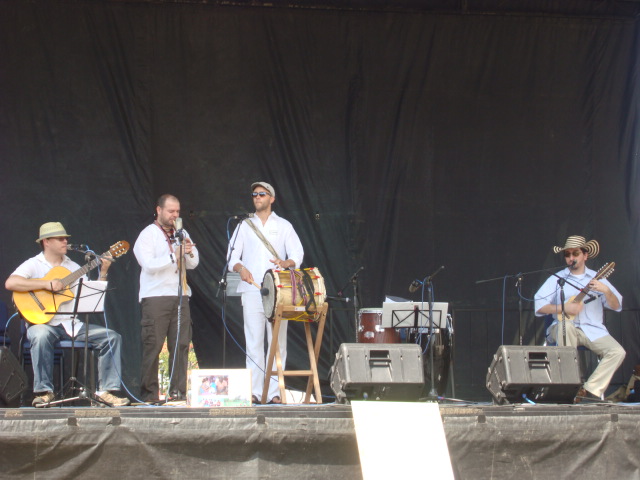
These next jokers took about half an hour to get their microphone cords straightened out. I almost got up and left. Then they played the best set of the day. They are Del Sur, a local band that plays South American Folk music. Check out the hats on these guys.
As they played, a little Incan abuelita got up and started dancing. She had to have been three feet tall, but layed down some of the most epic dance moves I've ever seen.
Of course, we caught it all on video:
The only thing better than a pickle surprise is a car show surprise. At the end of one of the four streets covered by festival goers, we happened upon the Urbana Motor Muster. This is one of the major annual events of the Illini Collector Car Club, an Urbana club started in 1961 by 6 guys who really liked old cars. This show had everything from a 20s era steam powered car to a hearse from the 80s.
The cars were parked close and they were surrounded by car enthusiasts, so it wasn't easy to get many good pictures. I did want to get one of Ainers posed in front of a car. Here she is standing next to a hardtop, two-door Oldsmobile 88 Holiday. I told her to give me a sexy pose. This is what I got:
The Muster featured a restored bus from the Champaign-Urbana City lines.
Started in the late 30s, this bus company hit its high water mark in 1958 with over 1 million passengers for the year. After Eisenhower invented the insterstate highway, though, everybody wanted a car and the company withered and died. The city government decided the bus line was too big to fail, so they funded a bail out, took over the line, and supported it with tax dollars. Now only socialists ride the bus.
The bus on display dated to 1958, the magic year. Unlike the 50s, anyone can sit where ever they want to on it now.
There were also, placed with an awkward proximity, booths for the Republicans...
and the Democrats.
I asked the Republicans if they hated women and poor people. They said no. I asked the Democrats if they hated America and freedom. They said no. So, that's settled. Turns out, they mainly disagree on things they have no control over, like the movement of the planets and the economy and cats. Also, they use different colors on their signs.
A little down the way from the pundits and the spitballers, we saw the folks from the Urbana Bible Education Center (located a few feet away in Lincoln Square Mall). They provide low cost Bibles and free Bible classes to the community. Low cost Bibles seem a bold move, given the competition: the Gideons still hand them out for free.
We also saw a military booth, set up in front of the Veteran's Memorial and operated by veterans.
I spent the most booth time at the Forest Preserve Booth, though I didn't get a picture of the nice ladies that worked there. Master Naturalists every one of them. Back when we lived in Austin, I considered taking the classes and becoming a Texas Master Naturalist. I asked her about the Illinois Master Naturalist program (modeled on the Texas program), but they only hold classes on Tuesday afternoon. I asked her if they have night and weekend classes for individuals who are gainfully employed. No. She said they had plenty of volunteer opportunities at which you are welcome whether you are a Master Naturalist or not. I had to explain to her that I don't want to make a difference. I just want to learn a bunch of stuff. But they do have a Tree ID course and several interesting programs.
This is their website:
http://www.ccfpd.org/
And these are examples of some of the events they host:
http://www.ccfpd.org/StarwatchesBatsCoyoteHike.pdf
Before we left, Ainers needed her obligatory bag of Kettle Corn.
Remember, Popcorn (Zhea mays everta) is a whole different animal from Sweet Corn (Zhea mays saccharata). Over 300 Illinois farms produce Popcorn, placing Illinois in 3rd place among Popcorn Producing States (Nebraska gets 1st place).
In 2003, Miss Holister, a teacher at Cunningham Elementary, had her 2nd and 3rd graders petition their state legislators as part of a civics project. The petition? To make Popcorn the State Snack Food of Illinois. Former corn farmer, Senator Larry Walsh sponsored the bill and Governor Rod Blagojevich (now incarcerated) signed it into law.
The kids became known as the Cunningham Kernel Kids.
After we left the festival grounds, we ran into a small table:
Some local politics for you. The Champaign-Urbana Citizens for Peace and Justice are protesting the new jail proposed. The county wants to spend 20 million on new jail facilities, the current jail, built in 1980, is in abysmal shape. Detractors argue that almost 60% of the inmate population is black, which is disproportional to the county demographics: only 17% of the county population is black. Also, they say the money should be spent on proactive measures: mental health centers, youth job training, substance abuse treatment, etc. One of the primary concerns is how tax dollars are being spent: why other programs that could alleviate overuse of the current jail are being underused and why the jail is beyond repair after only thirty years.


.jpg)




.JPG)
