This may be confusing to you since you don't exist yet. One day you will. Once you've learned enough English to work at McDonald's or blog about politics, you'll probably understand a little bit of the music you hear. You might stumble across the song Blurred Lines by Robin Thicke. Hopefully, this travesty of a song will have been banned by then, but it looks like these namby pamby liberals with their freedom of speech aren't going anywhere.
This song has tarnished the good name of American Pop Music and, I'm afraid, has taken us to a place as a nation we can't come back from. You'll say, Dad, explicitly treating women like sexual objects in song is nothing new: Big Joe Turner released Rebecca in 1944. First, Son, I would say Jazz doesn't count. Second, I would say even if it does, there are some subtle distinctions and I'm going to outline them here. In this fake letter I'm posting on the internet.
Robin Thicke recently performed this song while being the direct object of twerking on a recent awards show. And while he had no control over Mylie Cyrus' impromptu shenanigans, he was a married man singing a sex song, which is probably wildly misleading to people considering marriage. Also, Mylie Cyrus looks underage, so that makes it even worse. Granted, when a 23 year old John Lennon wrote and sang, "she was just seventeen if you know what I mean," he had already married Cynthia Powell after knocking her up. Here's the difference. A 36 year old man who looks like a skinny Russell Crowe: inappropriate. A 23 year old high school teacher: inappropriate. A 23 year old musician: what father of a 17 year old girl wouldn't be pleased?
What does the father have to do with it? Well, if you're going to treat a woman as a sexual object, it's important to take her previous owner into account and that's where Robin Thicke falls short. You can only do what you feel if her daddy is poor. If her daddy is rich, however, you should probably take her out for a meal first.
And let's face it. It's not so much the implicit glorification of infidelity, which has always been OK: Elvis sang Long Tall Sally in 1956. The difference you should note is that Mylie Cyrus is neither "built sweet" nor does she "have everything Uncle John needs."
Robin Thicke sings "you're an animal, baby," which strips away her agency and her intelligence. It is never OK to imply that a woman isn't a person. When the Beach Boys sing that they "dig a French bikini on Hawaiian island dolls," they're not talking about girls as though they were mindless bodies only valuable for their aesthetic attributes. It's a well known fact the Beach Boys actually collected dolls. Some animals are wild, but you shouldn't confuse this with The Troggs' Wild Thing, which is neither about women nor sex. It's a pastoral poem affirming the grooviness of the natural world. James Brown's Sex Machine isn't implying that woman was created for only one purpose. If you go back and listen carefully to the lyrics, he's clearly talking about erectile dysfunction. And that's OK.
Also, when Tom Jones sings What's New, Pussycat... come to think of it, Son, I don't want you listening to Tom Jones either.
One of the most disturbing aspects of all this is the public nature of this explicit sexuality. Twerking on a stage to a song about flirting in a club. The Drifters were gentlemen enough to make love under the boardwalk, hidden from the eyes of the people walking above. Tommy James hid what he was doing. He waited until he thought they were alone now before tumbling to the ground wrapped in arms.
The worst part of this song is the use of the B-word to describe a woman. I'm not even going to type it in his fake letter on the internet. Son, if you're ever confused about whether the B-word is appropriate as a lyric, follow this chart.
Performers who can use the B-word
Mick Jagger
Johnny Cash
Miles Davis
Woody Guthrie
Elton John
Singers who can NOT use the B-word
Robin Thicke
But mostly, Son, it's about class. Roy Orbison may well ask a pretty woman he only just met to be his tonight solely on the basis of her looks, but Robin Thicke, Son, is no Roy Orbison.
Urbana Sweet Corn Festival 2013
We did it again. It was so hot this year. I think we hit 85 degrees mid-day. Sweat was had by all.
Of course, the Motor Muster was there again.
Aine said, let's get a picture of the one with dead children in the back.
Instead of the old timey bus, this year they had a sweet Woody. Wait, what did I just say?
I scoured the streets for a 50s model Chevy Bel Air. I finally found one. Not the color I would have chosen, but it was the only one there.
Then we had to walk slowly around all the 1910s and 1920s model cars. Because of Downton.
And no Central Illinois festival is complete without overpriced beer in collector mugs.
Sure, it's the same price as a six pack, but can you drink a six pack in the middle of main street in front of your county courthouse? I didn't think so.
The One Community Stage had a lively performance by Bone, Jugs and Harmony (pun intended). They performed with whiskey jugs, kazoos, and all manner of ridiculous instruments. Aine said, I think this is kids' music. I said, no, these guys are for real. They're local and play venues all over town.
You're probably wondering, where are all the spectators? They're crowded in the shade of the building to the left. By this time in the day we hit the low 80s and people were passing out from heat exhaustion. All precautions had to be taken.
Kansas headlined the entertainment this year. Aine said we had to go since they play the theme song to Supernatural. I said, fine, but we leave as soon as they play Wayward Son. Wouldn't you know it. They played it last.
Here's videographic evidence that we were there. With the entire population of Champaign County. Forgive the sloppy camera work. The camera man had been drinking since three that afternoon.
The Blerch Shirts Have Arrived
We ordered Blerch shirts from the The Oatmeal website for the Pumpkin Classic 10K in Morton.
It's based on a six part comic you can read here: The Oatmeal
You only need to read the first part to understand the shirt, but I would suggest reading all six. Rocking the d20
So, a few of us decided we wanted to try out Dungeons and Dragons. It was decided that since I'm the only one not in grad school, therefore the only one with free time, I should be the one to learn the hundreds of rules and DM the first game.
In the picture above, you'll see the practice game from the other night where Aine, as a Level 1 Elf Wizard, defeated 4 Goblin Minions with her Magic Missile. That's right.
Coming Soon
Labor Day - Arthur Cheese Festival and the 5k Rat Race.
Hard Cheese - Three weeks to go!
A Jabbo Special St. Patrick's Day Edition
Last summer I married an Irish girl. Half-Irish, to be exact, the other half being Lowland Scottish. This makes me a contractual Hybernophile, or a lover of Irish stuff. The word comes from the Roman name for Ireland: Hybernia. The Irish also use Hybernia as the poetic name for Ireland, like Caledonia for Scotland, Britannia for the UK, and Columbia for the US (see also: District of).
In Gaelic, the Irish call their homeland Eire which comes the long way around from a Germanic goddess named Eriu. Don't feel bad: they don't have a monopoly on Germanic deities. We celebrate the resurrection of our Lord and Savior on a day named after the Germanic fertility goddes Eostre. Also, all the days of the week. Except the 7th one which we named after the baby-eating Titan of Roman mythology, Saturn (Cronus in Greek).
St. Patrick
Today, March 17th, the entire world celebrates St. Patrick's day. I'm wearing green as I type this. After a little research, I discovered that St. Patrick is NOT the guy on the Lucky Charms box and he DOESN'T have a pot of gold hidden at the end of the rainbow. Who knew?
His original name was Maewyn Succat. I'm not sure how to pronounce that. I tried saying it to Aine, but she replied, not now, I have a headache. Whatever that means. Mr. Succat was born in Roman Britain in 387 AD, almost 400 years after the life of Christ, but still before a Catholic council decided which books to include in the New Testament and which to condemn as heresy. That's why you've probably never read such classics as the Gospel of Thomas or the Shepherd of Hermas. True story: when archaeologists found a copy of the Gospel of Thomas at Nag Hammadi, they found excerpts from Plato's Republic buried with it.
Back to Roman Britain. Let that sink in a moment. The patron saint of Ireland was British. But so were our Founding Fathers.
St. Patrick's story begins when he was sixteen. This is no accident. In Irish and Scottish culture, sixteen is the age you officially reach adulthood. Both of Aine's parents started out on their own at age sixteen. When Aine turned sixteen, her dad handed over her birth certificate and said, well, good luck. Remember, Jesus began his ministry at age thirty, the age of adulthood in Jewish culture.
Patty was minding his own business, strolling along the shore, when Irish Pirates swept down from the stormy seas, tied him up, and shipped him back to Ireland. There, as a slave, he tended sheep for several years. One night, God came to him in a dream and told him to escape. He got up, walked down to the docks, climbed aboard a ship and sailed to Gaul, known today as France, where he learned about Christianity.
You're probably wanting a bit of history to orient yourself. St. Patrick probably arrived in Gaul after 400 AD. The 40th Pope was working in St. Peter's Basilica, finished in 320. In 380, Emperor Theodosius made Christianity the official state religion of the Roman Empire. In 410, the Goths sacked Rome, marking the end of the Classical Era and the beginning of the Middle Ages. The Synod of Hippo met in 393 and picked the books of the Bible. Tough luck, Apocalypse of Moses. Here's your take away: St. Patrick grew up in a Roman World, but one where Christianity was coming into its own. A hundred years before, they were still throwing Christians to the lions.
After working his way up to Bishop in the Church, Maewyn Succat, who had by now taken the name Patrick, returned to Ireland to convert the pagans.
Snake Symbolism Again
St. Patrick is the Abraham Lincoln of Ireland. Every few miles you find an official St. Patrick site and much of Irish identity is bound to his deeds and exploits. While converting the Irish and breaking the cultural power of the Druids, Patrick drove all the snakes from Ireland. Not content with that, he dug up all fossilized remains and expunged all references to snakes in ancient texts so we have no historical or archaeological evidence that snakes ever existed on the island. He explained the concept of the Trinity using the shamrock: one leaf (compound palmate) divided into three parts (leaflets). Remember that. Shamrock. Not Four Leaf Clover. If you make that mistake in front of an Irish person, he or probably she will curse at you in Gaelic. Take my word for it. I have in-laws. My favorite Patrick story is when he returned to his former master to pay his ransom. After all, Patrick deprived the poor man of property without due process. Hearing that his former slave had returned, the former master killed himself by setting fire to his house and dying in the flames.
Patrick died on March 17 (see what they did there?), 461 AD in Downpatrick, Ireland. Technically, Downpatrick is in Northern Ireland, which, while on the island of Ireland, isn't part of the nation of Ireland. It's part of the UK and therefore occupied by imperialist Sassenachs. Sassenach is the Gaelic word meaning Saxon, used as a derogatory term for those of Anglo Saxon descent. Also, it's what my mother in law calls me when I make her mad.
How It Became a Thing
You have to work through four stages to become a Saint. You know, like you have to have Bobcat, Wolf, Bear, and Webelos before you can get your Arrow of Light. Only, for Catholics, the badges are Servant of God, Venerable, Blessed, and then Saint. To be canonized by the Pope and reach the fourth level, you have to perform at least two miracles posthumously in an act of intercession.
Patrick was never canonized by a Pope. During the first 1000 years of Christianity, canonization occurred at the local (diocesan) level. Everyone already declared a saint at that point was sort of grandfathered in. The day of Patrick's death, March 17th, was made a feast day in Ireland in the 9th century. On the official Roman Catholic feast calendar, St. Patrick's day is marked Optional.
Celebrate Good Times Come On
Much of what we consider St. Patrick's Day tradition started among Irish immigrants in America and migrated back across the Atlantic. In Ireland, the day was celebrated as a holy day and they ate boiled bacon and cabbage. Lent was suspended for that day only.
Irish Protestants (go figure) started celebrating in America as early as the 1730s. The first St. Patrick's day parade occurred spontaneously in New York in the 1760s when Irish serving in the British Army marched down the street raising a ruckus. Not wanting to be outdone, Dublin and Belfast started hosting parades, too.
The Irish made the day a national holiday in 1903. Due to the Irish being Irish, the British, still in control of Ireland at the time, passed a law banning alcohol on March 17th. The Irish parliament voted to repeal the ban in 1970. The Irish government started hosting a yearly festival in the mid-90s.
In the United States, St. Patrick's day is a legal holiday in two places: Suffolk County, Massachusetts and Chatham County, Georgia. Chicago dyes the Chicago River green. Previously, they used a 100 lbs of vegetable dye which lasted a week. They've cut back to 40 lbs which only lasts 8 hours. Irish immigrants in the US started substituting corned beef for bacon and that has become the traditional meal for St. Patrick's day. Like black eyed peas and cabbage on New Year's. The Irish don't consider corned beef an Irish dish, but they serve it to tourists who think it is. Sort of like crispy tacos in Mexican Restaurants. I've never seen a Mexican eat a crispy taco.
Every year since 1991, the POTUS issues a proclamation declaring March as Irish Heritage Month and the Irish Taoiseach comes for an official visit. You pronounce Taoiseach like tee zhah, only when you get to the end, make a noise in your throat like you're hocking a loogie. When Irish people say Taoiseach, they mean Prime Minister. Which begs they question why they don't just say Prime Minister.
Wearing of the Green
The color associated with St. Patrick was blue. But we wear green. So it goes.
The Irish used to pin shamrocks to their lapels on St. Patrick's day. They called it The Wearing of the Green. You know, because a shamrock is green. It became a political statement during the Irish Rebellion of 1798. One that meant: "British go home." The 1798 rebellion just happened to be the bloodiest and most violent rebellion in Irish history. And there are plenty to choose from. Irish soldiers took the wearing of the green to another level by wearing all green uniforms and the rest is history.
So for the Irish, St. Patrick's day is not just a day to get drunk. It's their Thanksgiving, New Year's, Memorial Day, and 4th of July all rolled into one.
There's an old Irish ballad commemorating the wearing of the green. Like all Irish ballads, a lot of people die in it.
Parting Shot Erin Go Bragh means "Ireland Forever." It's an anglicisation of the Gaelic Eirinn go Brach. I have no idea how to pronounce it. In Scotland, they say Alba Gu Brath, meaning "Scotland Forever." You pronounce that one like: alpapa ku pra. I don't know why. See, there's old Gaelic which Scotland and Ireland share, then there's Modern Gaelic which they speak in Ireland and Scots Gaelic which they speak in Scotland. It's a mess.
Alba is the Scots Gaelic word for Scotland which comes from the Greek (go figure) Albion. Go bragh and gu brath literally mean "until Judgement Day."
Sean Connery has Alba Gu Brath tattooed on his arm.
And if you were curious: Sun Day, Moon Day, Tyr's Day, Wodin's Day, Thor's Day, Freya's Day. So there.
We had this arctic front come through the other day. It was cold. Outside. After I extracted Aine from campus, the perennial holiday favorite, Baby It's Cold Outside, came on the radio. We spent the next fifteen minutes arguing about who was singing that particular version.
I should note: the oldies station, during the month of December, plays only Christmas songs 24/7. At first, this information alarmed me. I thought, there are only so many Christmas songs out there, are they going to play the same ones over and over and over? Then I remembered, that this same station, for the other 11 months of the year, has four decades of music from which to select their repertoire, and every time I get in the car, I hear the same three or four songs. So, since December 1st, I have actually heard a greater variety of music.
Thinking about the aforementioned song, I wondered who sang the best version. Rather, I didn't care so much about the best version, but which version I liked the best. So I listened to 25 versions and rated them on a 9 point scale. The parameters included male performance, female performance, mood, and tempo. I found myself surprised by the results. Before we get to the results, though, a little history.
Frank Loesser wrote Baby, It's Cold Outside in 1944 as a conversational duet between two individuals he marked as the mouse and the wolf. He's the same guy that wrote the musicals Guys and Dolls and How to Succeed in Business Without Really Trying. He first performed the song with his wife, Lynn Garland, at a party hosted at their home, as a tactful way of inviting his guest to start gathering their coats and scarves. They performed the song at parties for years and Lynn always thought of it as "their song." When Loesser sold MGM the rights in 1948, Lynn was not very pleased.
The song gained its first national audience in the 1949 movie Neptune's Daughter, earning Loesser an Academy Award.
That year saw 8 different recordings of the song, two of them, the Dinah Shore/Buddy Clark version and the Margaret Whiting/John Mercer version, reached number 4 on the Billboard charts. The Whiting/Mercer, I gather from internetal evidence, is the popular standard.
The song teaches us two very important things: 1) the female brain is impaired by the cold and 2) if you just keep insisting, eventually she'll change her mind. Baby, It's Cold Outside has received its share of controversy and, indeed, it can be creepy at times. Take the line: "say, what's in this drink?" See also: rohypnol. The more times you hear this song in a row, the less romantic and the more insidious it sounds. After listening to it over 100 times across two days, all I can say for certain is that I never want to hear it again.
In explaining my results, I want to stress that they are completely subjective and not open for discussion or dissent.
The Wolf and Mouse parts can change from version to version. In some versions, they are both performed by men. In some, the man sings Mouse and the woman sings Wolf. I'm fine with both of those, but Wolf needs to sound dominant, but not manipulative. Mouse needs to sound savvy and complicit. I prefer Wolf to have a middle range sort of voice, like a cello. Too high and it doesn't sound dominant, too low and it's just off-putting. Mouse needs a smoky, sultry sort of voice, to let you know that Mouse knows what's going on, but he or she is putting a token resistance as a matter of form. Too high and Mouse sounds naive and in a bad situation. Too low and Mouse sounds like a dude. I also found the pacing important. I don't like the faster, frenetic versions of this song. I want to enjoy it. I will not be rushed. However, if the song is performed too slowly, it crumples like a soggy pumpkin. I prefer that Wolf and Mouse take turns. In some versions they constantly sing over each other and chaos ensues.
The very nearly perfect version of this song, by Drew Holcomb and the Neighbors (actually a husband-wife duet) loses points for being just a touch too fast. Otherwise, this is my go-to version. The Cee Lo Green/Christina Aguilera only suffers because Christina Aguilera's voice gets annoying at certain points. Best Wolf performances include Bob Hope, Cee Lo Green, Drew Holcomb, and Ben Folds. Best Mouse performances go to Nora Jones, Zoey Deschanel, Haley Reinhart, and Ellie Holcomb. Worst performances include Willie Nelson, Cerys Matthews, Tallulah Bankhead, and Lyle Lovett. The Absolute Worst Version was Nick and Jessica. I don't really know how to describe how abhorrent this version is. Don't listen to it.
Here are the results:
Score
Version
Year
8
Cee Lo Green, Christina Aguilera
2012
8
Louis Armstrong, Velma Middleton
1949
8
Drew Holcomb and the Neighbors
2009
8
Ben Folds, Sara Bareilles
2011
7
Zoey Deschanel, Leon Redbone (Elf Soundtrack)
2003
7
Zach Braff, Donald Faison (Scrubs Version)
2011
7
Bob Hope, Doris Day
1949
6
Chris Colfer, Darren Criss (Glee Version)
2010
6
Lady Antebellum
2008
6
Haley Reinhart, Casey Abrams (American Idol Season 10)
Champaign in Song
When Bob Dylan (that's right, I went there) was recording his 1969 album Nashville Skyline, Carl Perkins (you know him as the guy who wrote Blue Suede Shoes for Elvis and sometimes played with Johnny Cash, no relation to Luther Perkins, though) stopped by the studio and they wrote this song together:
This video uses photographs from both Champaign and Urbana. You'll notice some of the landmarks from previous posts. Jarling's Custard is right down the street from our apartment. And the Blind Pig is the bar we frequent in downtown Champaign.
Later, the Old 97s, a band from Dallas, Texas that likes to play in Austin, asked Bob Dylan (I did it again) if they could use the melody from his song Desolation Row with some new lyrics they had written.
Here they are playing that song at Waterloo Records in Austin (we bought stuff for our groomsmen and bridesmaids here):
Interesting story. I got really excited when I heard this Old 97s song. I jumped up and down a little bit, then raced down the hallway to tackle Aine out of her study chair. I said, you have to listen to this song. She shrugged. Oh, yeah, she said. I have that CD. I've had it for almost a year.
So, unlike my wife, I have chosen to SHARE this music with others.
At the Urbana Sweet Corn Festival, I kept passing this corner booth blasting some intense blues and a sign advertising CDs for ten bucks a pop. I thought, that's good blues for a local guy. Aine and I both have been curious about finding some local jazz and blues around the CU. You know: find a bar with live music, get into the scene. So I figured a good place to start would be this guy: Deak Harp. Only, I never saw anyone in the booth and the CD basket sat empty.
At one point, ready to leave and counting out tickets to buy a gigantic bag of Kettle Corn destined grow old and stale in the cabinet, I passed the booth and saw him. Deak Harp. Local blues legend. He wore a black driving cap and a goatee and dark sunglasses. He looked like Ray Wylie Hubbard and Harry Connick, Jr. and someone's dad hitting mid-life crisis, all rolled into one. I thought this guy's got to be legit. I stomped over and shook my ten dollar bill at him.
"I want one of your CDs," I said.
"Aww, yeah," he nodded. "You musta heard me playin' earlier."
"No," I said, waggling my ten. "I heard the music on the speakers. I like it. I want to hear more."
He snatched the Hamilton from my butter-greased fingers.
"Oh, that ain't me on the speakers. That's me on the CD, though. You want me to autograph it?"
Well, we listened to him on the drive home. He's got a wailing harmonica and a thumping base and scratchy feedback and all the usual blues lyrics. Pretty much everything you could want from a blues album.
I looked him up, this Deak Harp. Ole Deak learned his stuff from James Cotton who played with Muddy Waters. He stamps this genealogy all over his website, so it must mean something. You know, I studied under David Gaines who wrote an article for Texas Monthly about Kinky Friedman. So you should watch me smoke a cigar. Deak makes it explicit that he's playing in the Chicago Blues Style. I've found this appellation lobbed about rather flippantly as though anyone knows that the hell it means.
In case you don't, here's the cheap tour of blue history:
Country Blues came first, in the early 1900s. They played this guitar-only blues all acoustic, mostly because they didn't have electricity. These are your folk-blues singers: Furry Lewis, Mississippi John Hurt.
Delta Blues flourished in the 1920s and 1930s as a regional form of Country Blues, specifically along the Mississippi River in the state of Mississippi. They figured out electricity by this time, so it's plugged in. It's most famous for its use of the harmonica and the slide guitar. Also called the Bottleneck Style because, well, they would stick a bottleneck on their finger to do it. Think: John Lee Hooker.
Chicago Blues emerged as an new take on Delta Blues style in the 1950s. They play this blues louder. A lot louder. They use amplifiers and additional instruments like the drums, the trumpet, the sax, and the piano. Chicago Blues boasts the crooners you're probably most familiar with: Muddy Waters, Buddy Guy, Jimmy Reed... and our own Deak Harp.
All that said, ole Deak seemed like a swell guy and I would go hear him play sometime. I didn't get any pictures or video of him at the festival, but I found him on YouTube playing one of the songs on the album I bought:
You'll notice in the video he's playing three instruments at the same time which would have impressed me if I hadn't already seen Dick Van Dyke (of Danville) play seven:
This past weekend, 50 thousand people converged on the tiny hamlet of Urbana to participate in the annual Urbana Sweet Corn Festival. Held every August in the shadow of the Champaign County Courthouse, this festival bids farewell to summer and welcomes the yearly immigration of more than 40 thousand UofI students.
Unlike Austin festivals, both parking and entry are free. Friday and Saturday nights feature local blues, rock, and jazz bands. We missed the Jazz band Friday night because I was busy getting second place at Poker Night. Which means I broke even. However, I didn't miss the Sweet Corn Festival Mascot: Corny.
I know what you're thinking. You're thinking, James, if Illinois produces mainly Field Corn, where did they get all this Sweet Corn. For most of the 40 year history of this festival, promoters imported Sweet Corn from a variety of locations all over the US (one of the largest being Colorado... go figure). For the past two years, all the Sweet Corn for the festival came from one source: Maddox Sweet Corn Farm.
Jim and Ted Maddox started their 80 acre farm 15 years ago near the small town of Warrensburg (pop. 1300). You'll find Warrensville about 10 miles northwest of Decatur. They pick their corn fresh every morning to distribute to individual customers, roadside purveyors, and big chains like Wal-Mart. They sold unshucked corn for 5 bucks a bag at the festival.
You can't go to a Sweet Corn Festival without partaking of Sweet Corn, so we headed straight to the corn booth to purchase a cooked and buttered ear. This corn was fresh. You want to know how fresh? Here's how fresh: you had to pick the silky corn hairs out of it as you ate it. That's how fresh.
The corn cost a buck an ear. If you ride your bike, they give you a voucher for a free ear. We drove. While Aine's old new bike still functions in a satisfactory manner, the new old bike demonstrates a reluctance to brake effectively. That's not entirely true. The front brakes work fine. The back brakes not at all. Riding the new old bike feels akin to playing Russian Roulette with a trebuchet.
Back to the corn. I found this video on YouTube about the Maddox Sweet Corn Farm. Watch this:
The Maddox Bros also operate a Christmas Tree Farm. Illinois has over 500 Christmas tree growers producing almost 150 thousand Christmas trees annually. In case you were curious.
The Good Book says man can't live on corn alone, so we rounded out our culinary experience with a slice of Shepherd's Pie Pizza from a booth run by an Urbana pizzeria, Manolo's. They top their Shepherd's Pie Pizza with ground beef, mashed potatoes, and (of course) corn.
This festival had all the classical festival elements, including street vendors...
a dunking booth...
and a petting zoo.
We didn't go into the petting zoo. It didn't feel right without Mr. Higgins. But word on the street had it that this one included an alpaca, a kangaroo, and a camel. We got a close up of the camel.
We spent most of our time near the One Community Together Stage. The community stage was sponsered by the Sousa Archives and Center for American Music, named in honor of John Philip Sousa, best known for writing the Stars and Stripes Forever and dressing like a kaiser. The Sousa, an archival branch of the UofI library system, works to support and preserve music of all the cultures that make up our great Melting Pot.
First we saw a Korean Drum performance. They were rockin'.
We also watched a Balinese ensemble. One of the band members clearly doesn't look Balinese. But we forgave this small indiscretion when we heard them. The instruments look and sound incredible. It's not the type of music that gives you an adrenaline rush. I wouldn't listen to this while exercising. But, as Aine mentioned, the music seems to have no clear pattern, so it's amazing they were able to memorize these songs.
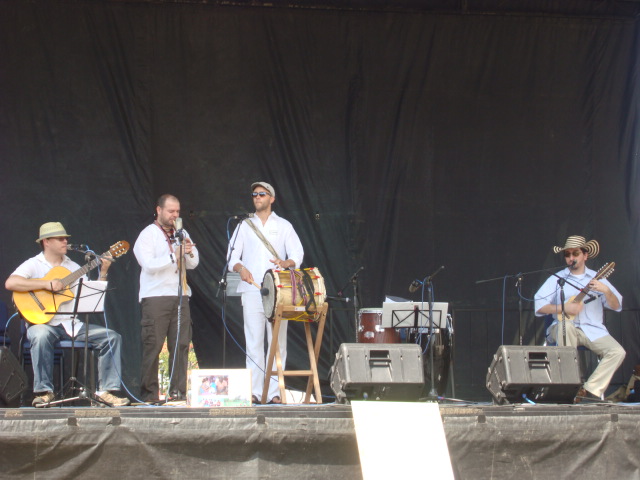
These next jokers took about half an hour to get their microphone cords straightened out. I almost got up and left. Then they played the best set of the day. They are Del Sur, a local band that plays South American Folk music. Check out the hats on these guys.
As they played, a little Incan abuelita got up and started dancing. She had to have been three feet tall, but layed down some of the most epic dance moves I've ever seen.
Of course, we caught it all on video:
The only thing better than a pickle surprise is a car show surprise. At the end of one of the four streets covered by festival goers, we happened upon the Urbana Motor Muster. This is one of the major annual events of the Illini Collector Car Club, an Urbana club started in 1961 by 6 guys who really liked old cars. This show had everything from a 20s era steam powered car to a hearse from the 80s.
The cars were parked close and they were surrounded by car enthusiasts, so it wasn't easy to get many good pictures. I did want to get one of Ainers posed in front of a car. Here she is standing next to a hardtop, two-door Oldsmobile 88 Holiday. I told her to give me a sexy pose. This is what I got:
The Muster featured a restored bus from the Champaign-Urbana City lines.
Started in the late 30s, this bus company hit its high water mark in 1958 with over 1 million passengers for the year. After Eisenhower invented the insterstate highway, though, everybody wanted a car and the company withered and died. The city government decided the bus line was too big to fail, so they funded a bail out, took over the line, and supported it with tax dollars. Now only socialists ride the bus.
The bus on display dated to 1958, the magic year. Unlike the 50s, anyone can sit where ever they want to on it now.
There were also, placed with an awkward proximity, booths for the Republicans...
and the Democrats.
I asked the Republicans if they hated women and poor people. They said no. I asked the Democrats if they hated America and freedom. They said no. So, that's settled. Turns out, they mainly disagree on things they have no control over, like the movement of the planets and the economy and cats. Also, they use different colors on their signs.
A little down the way from the pundits and the spitballers, we saw the folks from the Urbana Bible Education Center (located a few feet away in Lincoln Square Mall). They provide low cost Bibles and free Bible classes to the community. Low cost Bibles seem a bold move, given the competition: the Gideons still hand them out for free.
We also saw a military booth, set up in front of the Veteran's Memorial and operated by veterans.
I spent the most booth time at the Forest Preserve Booth, though I didn't get a picture of the nice ladies that worked there. Master Naturalists every one of them. Back when we lived in Austin, I considered taking the classes and becoming a Texas Master Naturalist. I asked her about the Illinois Master Naturalist program (modeled on the Texas program), but they only hold classes on Tuesday afternoon. I asked her if they have night and weekend classes for individuals who are gainfully employed. No. She said they had plenty of volunteer opportunities at which you are welcome whether you are a Master Naturalist or not. I had to explain to her that I don't want to make a difference. I just want to learn a bunch of stuff. But they do have a Tree ID course and several interesting programs.
This is their website:
http://www.ccfpd.org/
And these are examples of some of the events they host:
http://www.ccfpd.org/StarwatchesBatsCoyoteHike.pdf
Before we left, Ainers needed her obligatory bag of Kettle Corn.
Remember, Popcorn (Zhea mays everta) is a whole different animal from Sweet Corn (Zhea mays saccharata). Over 300 Illinois farms produce Popcorn, placing Illinois in 3rd place among Popcorn Producing States (Nebraska gets 1st place).
In 2003, Miss Holister, a teacher at Cunningham Elementary, had her 2nd and 3rd graders petition their state legislators as part of a civics project. The petition? To make Popcorn the State Snack Food of Illinois. Former corn farmer, Senator Larry Walsh sponsored the bill and Governor Rod Blagojevich (now incarcerated) signed it into law.
The kids became known as the Cunningham Kernel Kids.
After we left the festival grounds, we ran into a small table:
Some local politics for you. The Champaign-Urbana Citizens for Peace and Justice are protesting the new jail proposed. The county wants to spend 20 million on new jail facilities, the current jail, built in 1980, is in abysmal shape. Detractors argue that almost 60% of the inmate population is black, which is disproportional to the county demographics: only 17% of the county population is black. Also, they say the money should be spent on proactive measures: mental health centers, youth job training, substance abuse treatment, etc. One of the primary concerns is how tax dollars are being spent: why other programs that could alleviate overuse of the current jail are being underused and why the jail is beyond repair after only thirty years.




.JPG)
