Old Stone Arch Bridge
Just over the Urbana line, you can find a nondescript drainage basin masquerading as a park. If you park across from student housing that looks like all the other student housing in town, get out of your car, and enter the park, you'll run into this bizarre hump of old rocks.

You won't know this is a crucial piece of Champaign-Urbana history, one, because it looks like a stupid pile of rocks, and two, because you have to crawl under a bush to read the historical marker.

Go back to the first picture. See the bush hiding the Yaris? The historical marker is under that. What you don't know you're standing on is the Old Stone Arch Bridge.

In the 1850s, the city planners of Urbana worked out the details for a horse drawn street line connecting downtown Urbana with the Illinois Central running through Champaign. Work halted when the Democrats attacked Fort Sumter. Everyone became occupied with four years of a little political squabble called the Civil War. Money and material came in short supply.
In 1863, work commenced on the line and they finished it a few years later. Historians think the line saved Urbana, otherwise cut off from the Illinois Central, from shriveling like a raisin, both economically and geographically. If not for this weird little bridge, Urbana might not exist today.
The original bridge carried the horsedrawn line over Boneyard Creek, but the bridge ran the length of the creek for a hundred feet or more, creating a sort of underground canal. Electric street cars replaced the horse drawn line in the 1930s and the bridge fell into disuse and disrepair. In fact, the whole of Boneyard Creek was a mess.
The city, in 1981, decided to restore and rennovate the creek and build a park. They tore down all but a ten foot section of the bridge, but lobbied to have that section added to the National Register of Historic Places. If you cross the bridge and walk down to the water, you'll see Urbana history in all it's glory.

You'll also see it forms an almost perfect semi-circular arch. Which brings me to my love affair with the arch.
Why I Love the Arch
The arch has got to be the most brilliant architectural element ever created. Before the arch, all open spaces (windows, doorways, halls, rooms) found support in the old post and lintel (beam) construction. Think of Stonehenge. Think of a Greek temple. Turn around and look at the nearest doorway. Pretty boring. You can only cover so much open space, though, before a lintel or beam becomes too heavy and cracks under its own weight. The arch, invented in Mesopotamia and perfected by the Romans, can span much larger openings and bear more weight.
No matter how fancy it looks, all architecture uses the same basic shapes you learned in kindergarten: circle, square, triangle. An Egyptian pyramid consists of four triangles around a square base. Greek temples use squares, rectangles, and triangles. The Roman Arch works its magic with exactly half a circle, a semicircle.
 |
| Public Domain Image |
Engineers will tell you this semicircle converts tensile stress into compressive stress. That sounds like gibberish, but stick with me. The weight pressing down on a ceiling or a wall or any horizontal structure, that's your tensile stress. This vertical force moves around the circumference of the arch to the bottom where it becomes a horizontal force.
 |
| I did the arrows. |
When you have two arches back to back, the horizontal forces cancel out and get pushed down the length of a column. There's your compressive stress.
 |
| This one too. |
So you can have a row of arches (called an arcade) that takes all the weight of a building and transfers it to a few sturdy columns. You only have a problem when you get to the end of the row. You have nothing to cancel out the horizontal force of the last arch. The Romans solved this problem with the buttress, basically a pile of masonry at the end of an arcade or the side of a building.
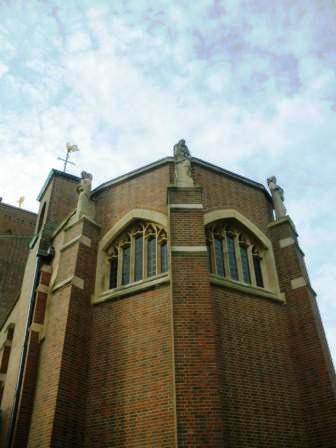 |
| By Weglinde Gordon Lawson |
These buttresses are keeping the interior arches from blowing out the side of this church. It doesn't look very pretty, does it? Gothic architects didn't think so either. They opened things up a bit by moving the buttress away from the side of the building and transferring the force along a sort of semi arch. They called this the flying buttress.
 |
| By Pearson Scott Foresman |
You can see flying buttresses in action at Notre Dame in Paris (yes, the picture is small, just click on it):
 |
| By Matthew F from GA |
Now, remember what I said about all architecture using the same few shapes? If you take an semicircle arch and spin it like a top, you get a dome. If you take two semicircles and lay them over each other, you get a sort of pointed shape where they overlap. See:
 |
| Public Domain Image |
This pointed shape forms your basic Gothic Arch and it works just as well as a Roman Arch.
 |
| Public Domain Image |
Move the circles closer together and you get a Tudor Arch.
 |
| By Elliott Simpson |
This is King's Chapel in Cambridge, built by one of the Henries. Aine's seen it in person. That concludes your architecture lesson for today.


