I forgot to mention this in my Anniversary Weekend post. We were on our way out of Monticello, when I saw this from the road. I had Aine pull over so I could get a picture.
Up here in the Monsanto Fields of the North, a Lone Star shines.
The adventures of a Texas boy, transplanted in the corn fields of Illinois.
Showing posts with label state symbols. Show all posts
6/23/13
5/2/13
The Irish Invasion of Springfield
Springfield was not spared the Critical Eire Eye. We slipped in some Lincolnalia during the trip to Bloomington-Normal, but Anne was on her toes this time around. No funny business.
Frank Lloyd Wright
Susan Lawrence Dana, a socialite and rich widow from the Springfield area, hired Frank Lloyd Wright to design her house in 1902. According to the tour guide, she handed him a blank checkbook and told him to go crazy. And crazy he went. Prairie Style Crazy.
His design borrowed heavily from Japanese influences (even though this house predated his first trip to Japan). You can see it in the eaves and corners.
We couldn't get any pictures of the inside, but it had amazing stained glass, a barrel vault, an open floor plan (from a time before an open floor plan was a thing), multiple levels, and back passageways. It had a Downton-esque servants' quarters and a bowling alley in the basement. The house interior was so big and complex, I felt lost most of the time.
Like the David Davis home in Bloomington, the Dana Thomas house is a National Historic Landmark.
Cathedral of the Immaculate Conception
To be a Cathedral, a church must have a cathedra, Latin for seat or throne. Catholics use cathedra to denote the office (or seat) of a bishop. Some Cathedrals have literal thrones, but I didn't see it in this one. Built in 1927 in Mankato Stone (a yellow limestone from Minnesota), this Greek Revival church has served as the seat for the Diocese of Springfield.
It even has gryphons.
Having grown up Baptist, I forget about the size of Catholic churches and they blow me away every time I go. Baptist churches, as a rule, are small, intimate affairs. Your attention focuses down and around you, toward the community. The pulpit has a central location, surrounded by pews. In Catholic churches, I find myself staring up the entire time. Everything is big and monumental and full of light. You feel small and awestruck. Even the pulpit has been placed to the side, unobtrusively.
Here's a close shot of the coffered ceiling and the upper row of windows called the clerestory.
This Cathedral is famous for having two stained glass windows devoted to American Presidents. One Lincoln and one Washington.
It also had a clock which none of us had ever seen inside a church ever.
We timed our visit just before Palm Sunday, so the palms had been placed beside the baptismal.
Norb Andy's Tabarin
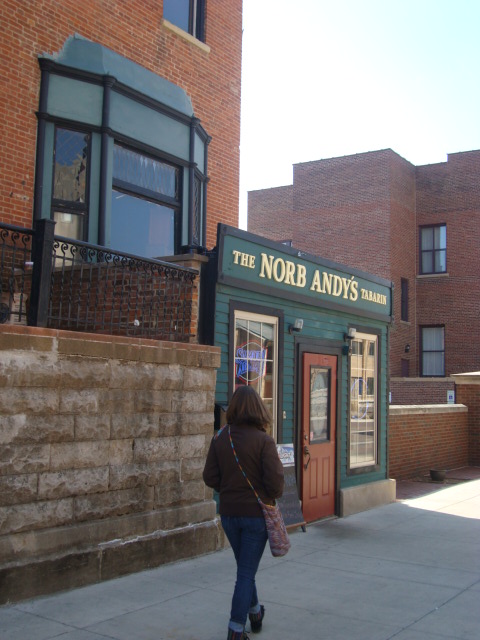
Lunchtime. The internet won't tell me what tabarin means, but I think it's Gaelic for small, dingy bar with amazing food. Norb Andy opened his bar in 1937, four years after the repeal of Prohibition, just in time for the Mid-Depression Recession. This weird little facade, sticking out of the front of the Hickox Building (1830), leads down to the basement. This basement held Sangamo Club meetings (a fancy gentleman's club) and served as a speakeasy during the 1920s.
Springfield has about a dozen Irish pubs. Each of them serves a Horseshoe Sandwich. I felt it my duty to try Norb's.
The beef didn't have as much seasoning and flavor as the patty served by D'arcy's Pint, but I liked Norb's cheese sauce and fries better.
Herndon Slept Here
I had Aine stop so I could get a picture of this Lincoln statue. Anne refused to be duped a second day in a row and stayed in the car. I passed a cool little Lincoln Gift Shop, full of Lincoln knick-knacks and tchotchkes. You could buy your own hat or beard there.
I thought that was pretty nifty until I turned the corner and ran into this.
On the third floor of the building on the left, Lincoln practiced law with his partner and biographer William Herndon for almost 30 years.
Down below, on the street, I found what I trekked down the street for: Lincoln #16.
Tthe kid standing next to the happy couple, Willie, is waving to his older brother Robert across the sidewalk (you can see Union Station in the background).
The Lincolns sent Robert off to Harvard during their time in Washington. He graduated just in time to join Grant's staff for the last two months of the war. Robert later served as Secretary of War under Garfield and Arthur and as Ambassador to the UK under Harrison. After retiring from public service to practice law, he served as general council for the Pullman Palace Car Company during the Pullman Strike of 1895 (during Altgeld's governorship, gave us Labor Day). He was present or nearby for three Presidential assassinations: his father's, Garfield's, and Mckinley's.
Back to the other three. Of this trio, only Mary would return from Washington DC alive.
Illinois State Museum
To walk off the heavy lunch, we stopped by the Illinois State Museum. This museum started in 1877, originally housed in the capitol building, but it got kicked out in the 1920s when the collection grew too large. It moved to its current location in the 1960s.
This museum would be perfect for middle school/junior high age visitors. As a 33 year old with a belly full of horseshoe, I found myself a little under-engaged most of the time.
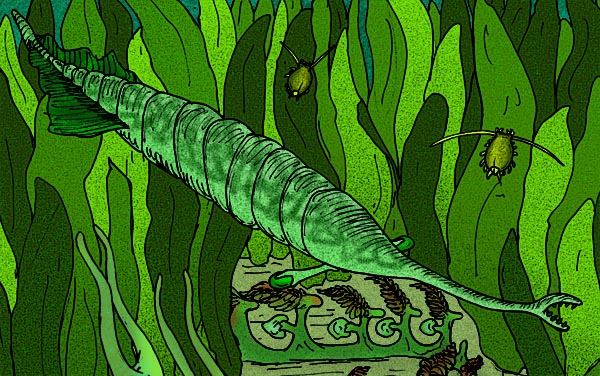
However, they did have specimens and a model of our State Fossil, the Tully Monster.
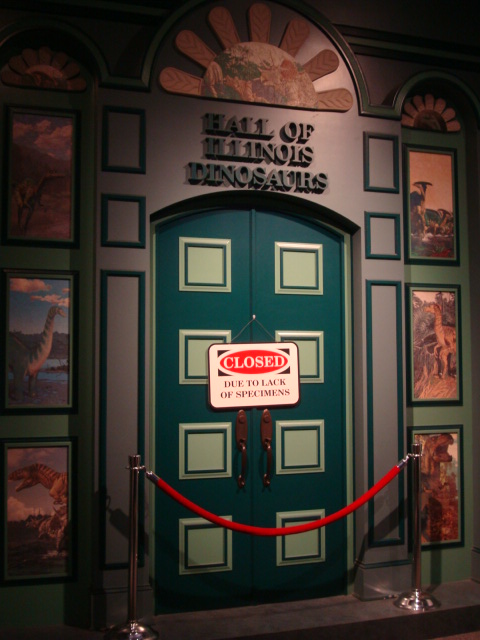
We found the Dinosaur Exhibit closed, which pretty much broke my heart.
But they did have a mammoth and a giant beaver sort of thing.
We had to take an escalator up to the top floor. The bricks were placed parallel to the escalator which made the whole experience disorienting. I kept feeling like I stood on a conveyor belt that was going to spit me into a hole.
Upstairs they had an exhibit dedicated to Mississippian Culture. Apparently, Mississippian women didn't wear shirts, which made me a little uncomfortable. I mean, there are kids running around and I'm looking at boobs. But I was able to get an G-rated picture. Look at this guy.
Quilts
Upstairs we also perused an exhibit of quilts made by women during the Civil War.
These remained in pretty good shape for being 150 years old and most of them were more complex and intricate than I expected.
After that we were toast. So we pretty much went home.
Parting Shot
Crankles likes spending time with Granny Annie.
Piglet not so much, but she does sit like a lady with her paws crossed.
11/5/12
State Symbols (Part 2)
State Insect
In 1975, a third grader from Decatur proposed that Illinois make the Monarch Butterfly its state insect. After overwhelming political pressure from schoolchildren, the legislature caved and passed a bill apotheosizing the butterfly.
The Monarch Butterfly (Danaus plexippus) has been legislated into official status by 6 other states, including Alabama and Texas. The only butterfly that migrates, the Monarch flies south to Mexico in the fall and returns in the spring. It's also one of the few insects that can make a transatlantic flight. The antennae of the Monarch contain a chemical called cryptochrome which reacts to light on the violet or blue end of the spectrum. When activated by blue light, cryptochrome becomes sensitive to the earth's magnetic field. Monarchs can't tell the difference between north and south, but they can align themselves on the north-south magnetic lines. It's basically a chemical compass. Many migratory birds have this chemical in their eyes. Don't feel bad. Humans also have cryptochromes that play a role in circadian rhythms, or your sleep-wake cycle. Some scientists think cryptochromes might provide insight into seasonal affective disorder.
The Monarch butterfly has no natural predators. The Monarch caterpillar eats milkweed and only milkweed. A chemical in milkweed, cardiac glycoside, builds up in the caterpillar's body and persists into adulthood. This chemical, often used medically in patients with heart failure, causes strong heart contractions. In an otherwise healthy individual, it can cause a heart attack. Butterflies don't have hearts (insects have a sort of open pump that swishes fluid around inside their body cavities), but birds and mammals who try to eat the Monarch do. Predators have long since learned to give the bug wide berth. Indigenous people from South America used extracts from milkweed to poison the tips of their arrows.
In the early 90s, then-representative Leon Panetta of California authored a bill nominating the Monarch Butterfly as national insect of the United States. Representative Steve Neal of North Carolina claimed any insect representing monarchy has no place in a Democratic society. He wrote a bill proposing the Honey Bee as a hardworking, Biblically-noted alternative to the monarchist tendencies of Panetta. Around this time, the Africanized Honey Bee crossed the Rio Grande. Also, the bee is totally Communist. Both bills died in sub-committee.
State Soil
Drummer Silty Clay Loam. The name Drummer comes from Drummer Creek, a tributary that flows into the Sangamon River just north of Champaign. Loam is a soil type that consists of sand, clay, and silt in specific quantities. Sand and silt both appear as rounded grains, sand visible to the naked eye and silt visible under a microscope. Clay, under a microscope, looks like flat, little plates. Imagine you have a shrink ray like Rick Moranis in Honey, I Shrunk the Kids. You shrink yourself to the point that sand grains look like large beach balls. At that size, you could use silt grains as golf balls and if you put clay particles in a bowl, they would look like corn flakes. Now unshrink yourself. Mix all those particles together and you have the dark, fertile loam, the best possible soil for growing field corn, field soybeans, and Christmas trees.
You can thank glaciation for much of the terrain in Illinois. As recently as the Pleistocene Era, about 75,000 years ago (back when we had woolly mammoths), a glacier covered most of Illinois. No one knows why a glacier advances or recedes, since climate change is obviously a myth, but when it did recede, it left the Illinois we know and love today.
Glaciers begin their lives as big piles of snow. The piles get so large that the snow compacts into giant cakes of ice that slide downhill. Voila! As the ice sheets migrate, drawn by the siren song of gravity, they grind all the rock beneath them into fine particles, like sand, silt, or clay. The Illinois glacier stopped near the Mississippi River, then started to melt. As it melted it revealed the silty clay loam that covers most of the state.
All of the major Illinois rivers, the Illinois, the Sangamon, the Vermillion, the Kaskaskia, were formed as melting glacier water cut through the soft loam looking for a bigger body of water to join.
It also left some other features, peculiar to glacial activity. If a big chunk of ice breaks away from the glacier body, it melts by itself. I mean really big chunk of ice, some were a mile or more across. As the ice melts, it soaks the soil beneath it, making it soft. The weight of the ice chunk pushes down into the soft soil and sediment washing away from the melting glacier piles up around it. A cauldron-like depression forms, called a kettle. Kettles, when they melt, can form these roundish, deep kettle lakes like you see across Siberia and Northern Alaska (Wiley Post flew Will Rogers into one of these). Thoreau lived next to a kettle lake for a while called Walden Pond. Sometimes, though, if decomposing organic matter creates acidic conditions, the kettle becomes a bog. Volo Bog northwest of Chicago is one such bog.
My favorite glacial formation is called a moraine. Glaciers bulldoze massive piles of soil, rocks, and boulders in front of them as they move downhill. When they recede, you're left with a ridge called a moraine. If you've ever driven to Alberta, Canada, you had to drive through a moraine in the southern part of the province. Just northwest of Champaign, you can see glacier droppings at Moraine View State Park.
Here's where it gets crazy. Long Island in New York is a moraine formed by glacier activity. If you look at a map, you can see the mountain corridor that the glacier moved through, piling up mounds of rock and dirt that would later make a home for Brooklyn, Queens, and the Hamptons. The glacier eventually melted, leaving behind the Hudson River.
In 1975, a third grader from Decatur proposed that Illinois make the Monarch Butterfly its state insect. After overwhelming political pressure from schoolchildren, the legislature caved and passed a bill apotheosizing the butterfly.
![]() |
| Tony Hisgett |
The Monarch butterfly has no natural predators. The Monarch caterpillar eats milkweed and only milkweed. A chemical in milkweed, cardiac glycoside, builds up in the caterpillar's body and persists into adulthood. This chemical, often used medically in patients with heart failure, causes strong heart contractions. In an otherwise healthy individual, it can cause a heart attack. Butterflies don't have hearts (insects have a sort of open pump that swishes fluid around inside their body cavities), but birds and mammals who try to eat the Monarch do. Predators have long since learned to give the bug wide berth. Indigenous people from South America used extracts from milkweed to poison the tips of their arrows.
In the early 90s, then-representative Leon Panetta of California authored a bill nominating the Monarch Butterfly as national insect of the United States. Representative Steve Neal of North Carolina claimed any insect representing monarchy has no place in a Democratic society. He wrote a bill proposing the Honey Bee as a hardworking, Biblically-noted alternative to the monarchist tendencies of Panetta. Around this time, the Africanized Honey Bee crossed the Rio Grande. Also, the bee is totally Communist. Both bills died in sub-committee.
State Soil
Drummer Silty Clay Loam. The name Drummer comes from Drummer Creek, a tributary that flows into the Sangamon River just north of Champaign. Loam is a soil type that consists of sand, clay, and silt in specific quantities. Sand and silt both appear as rounded grains, sand visible to the naked eye and silt visible under a microscope. Clay, under a microscope, looks like flat, little plates. Imagine you have a shrink ray like Rick Moranis in Honey, I Shrunk the Kids. You shrink yourself to the point that sand grains look like large beach balls. At that size, you could use silt grains as golf balls and if you put clay particles in a bowl, they would look like corn flakes. Now unshrink yourself. Mix all those particles together and you have the dark, fertile loam, the best possible soil for growing field corn, field soybeans, and Christmas trees.
You can thank glaciation for much of the terrain in Illinois. As recently as the Pleistocene Era, about 75,000 years ago (back when we had woolly mammoths), a glacier covered most of Illinois. No one knows why a glacier advances or recedes, since climate change is obviously a myth, but when it did recede, it left the Illinois we know and love today.
Glaciers begin their lives as big piles of snow. The piles get so large that the snow compacts into giant cakes of ice that slide downhill. Voila! As the ice sheets migrate, drawn by the siren song of gravity, they grind all the rock beneath them into fine particles, like sand, silt, or clay. The Illinois glacier stopped near the Mississippi River, then started to melt. As it melted it revealed the silty clay loam that covers most of the state.
![]() |
| http://dnr.state.il.us/education/biodiversity/emaps.gif |
It also left some other features, peculiar to glacial activity. If a big chunk of ice breaks away from the glacier body, it melts by itself. I mean really big chunk of ice, some were a mile or more across. As the ice melts, it soaks the soil beneath it, making it soft. The weight of the ice chunk pushes down into the soft soil and sediment washing away from the melting glacier piles up around it. A cauldron-like depression forms, called a kettle. Kettles, when they melt, can form these roundish, deep kettle lakes like you see across Siberia and Northern Alaska (Wiley Post flew Will Rogers into one of these). Thoreau lived next to a kettle lake for a while called Walden Pond. Sometimes, though, if decomposing organic matter creates acidic conditions, the kettle becomes a bog. Volo Bog northwest of Chicago is one such bog.
My favorite glacial formation is called a moraine. Glaciers bulldoze massive piles of soil, rocks, and boulders in front of them as they move downhill. When they recede, you're left with a ridge called a moraine. If you've ever driven to Alberta, Canada, you had to drive through a moraine in the southern part of the province. Just northwest of Champaign, you can see glacier droppings at Moraine View State Park.
Here's where it gets crazy. Long Island in New York is a moraine formed by glacier activity. If you look at a map, you can see the mountain corridor that the glacier moved through, piling up mounds of rock and dirt that would later make a home for Brooklyn, Queens, and the Hamptons. The glacier eventually melted, leaving behind the Hudson River.
![]() |
| Sémhur |
10/31/12
State Symbols (Part 1)
State Dance
Illinoyances chose the Square Dance as their state dance. So did the citizens of 22 other states. In fact, due to its popularity, our esteemed legislators in Washington, D.C. have introduced 30 different bills in the past century to make this this official national dance of the United States. For various reasons, the bill never gets passed. If a Republican authors the bill, Democrats claim it demeans women and marginalizes non-white minorities. If the bill comes from a Democrat, Republicans fear it signifies another form of governmental control over our lives. I mean, if the government can tell us what dance to dance, where will it end?
Better question: where did it begin? Square dancing, I mean, not Big Government. Seventeenth century England, of course. Come to think of it, that would answer either question. The early English settlers brought from England the rural dance craze known as the Morris Dance. Everybody was doing it.
Morris Dancers:
Only, the Morris Dance had specific steps that the dancers had to memorize, which wasn't very democratic, so Americans had one person call out the steps to the dancers. Sound familiar? By the 1800s, the Morris Dance had evolved into a form very similar to the Square Dance we know and love today. But, as the 1800s progressed, the Square Dance fell out of favor with the kiddos. They prefered the Polka and the Waltz, dances which allow you to cozy up next to that special someone without raising any eyebrows. Let's face it. The Square Dance just isn't as sexy as the Polka.
Enter Henry Ford. When he wasn't inventing cars or making rubber out of Goldenrods, he was cultivating an appreciation of America's past. He wanted to preserve New England heritage and at the same time modernize it. He's the man responsible for the edgy and hip modern form of the Square Dance. Popularity swelled until the 1940s when it became a full fledged fad. We're talking on par with the Macarena or the Electric Slide.
The renewed interest in Square Dancing fueled a thirst for other parts of folk culture and led to the Folk Revival of the 1950s. The Folk Revival gave us singers like Burl Ives, Harry Belafonte, the Kingston Trio, and yes... Bob Dylan.
State Fossil
The Tully Monster (Tullimonstrum gregarium). Coming from Texas, where we have the Chupacabra, I was intrigued at the idea of an Illinois Monster. Then I saw a picture. Francis Tully discovered the first fossil in 1958 in Grundy County (not the Grundy County of John Michael Montgomery fame, it pains me to say: that one's in Tennesee).
Since then, over 100 fossils of this little monster have been found along Mazon Creek, a tributary to the Illinois River that flows through Grundy County. Due to the importance of the Mazon Creek Deposits, the government declared it a National Historic Site.
The area features a large shale deposit. Shale is basically fossilized mud. That's important. If a T-Rex croaks on the savannah, scavengers and bacteria eat everything but the bones. When you go to a museum, you can see its skeletal structure, but you don't know anything about its skin, organs, feathers (yes, they had feathers, but that's a different discussion altogether). Those things that get eaten away are called soft tissues.
If a critter kicks the bucket and sinks into some soft mud, where the scavengers can't sniff it out and the bacteria can't breathe, the soft tissue gets preserved. That's why Mazon Creek is so important: it used to be a giant mudhole. So, we have soft tissue preserved for prehistoric organism that aren't found anywhere else in the world.
At Mazon Creek, scientist have found ancient mosses, ferns, ginkos. They've also found worms, jellyfish, crustaceans, snails, and Tully Monsters.
The Monster itself measured about a foot long, had a weird little proboscis with teeth and wimpy little arm things. The teeth indicate that the monster was a savage killing machine, so I'm sure there were creatures smaller than a foot that were terrified of it.
For more information about Mazon Creek:
http://www.museum.state.il.us/exhibits/mazon_creek/MazonCreekSite.html
Illinoyances chose the Square Dance as their state dance. So did the citizens of 22 other states. In fact, due to its popularity, our esteemed legislators in Washington, D.C. have introduced 30 different bills in the past century to make this this official national dance of the United States. For various reasons, the bill never gets passed. If a Republican authors the bill, Democrats claim it demeans women and marginalizes non-white minorities. If the bill comes from a Democrat, Republicans fear it signifies another form of governmental control over our lives. I mean, if the government can tell us what dance to dance, where will it end?
![]() |
| Deirdre |
Morris Dancers:
![]() |
| Simon Knights |
Enter Henry Ford. When he wasn't inventing cars or making rubber out of Goldenrods, he was cultivating an appreciation of America's past. He wanted to preserve New England heritage and at the same time modernize it. He's the man responsible for the edgy and hip modern form of the Square Dance. Popularity swelled until the 1940s when it became a full fledged fad. We're talking on par with the Macarena or the Electric Slide.
![]() |
| Public Domain |
State Fossil
The Tully Monster (Tullimonstrum gregarium). Coming from Texas, where we have the Chupacabra, I was intrigued at the idea of an Illinois Monster. Then I saw a picture. Francis Tully discovered the first fossil in 1958 in Grundy County (not the Grundy County of John Michael Montgomery fame, it pains me to say: that one's in Tennesee).
| Ghedoghedo |
The area features a large shale deposit. Shale is basically fossilized mud. That's important. If a T-Rex croaks on the savannah, scavengers and bacteria eat everything but the bones. When you go to a museum, you can see its skeletal structure, but you don't know anything about its skin, organs, feathers (yes, they had feathers, but that's a different discussion altogether). Those things that get eaten away are called soft tissues.
If a critter kicks the bucket and sinks into some soft mud, where the scavengers can't sniff it out and the bacteria can't breathe, the soft tissue gets preserved. That's why Mazon Creek is so important: it used to be a giant mudhole. So, we have soft tissue preserved for prehistoric organism that aren't found anywhere else in the world.
At Mazon Creek, scientist have found ancient mosses, ferns, ginkos. They've also found worms, jellyfish, crustaceans, snails, and Tully Monsters.
The Monster itself measured about a foot long, had a weird little proboscis with teeth and wimpy little arm things. The teeth indicate that the monster was a savage killing machine, so I'm sure there were creatures smaller than a foot that were terrified of it.
![]() |
| Apokryltaros |
http://www.museum.state.il.us/exhibits/mazon_creek/MazonCreekSite.html
Subscribe to:
Posts (Atom)
.jpg)